Every country, era, movement, you name it, has its icons – instant recognisably images of people or places that can identify or personify it. Socialist Yugoslavia has plenty of them – Tito, abstract spomeniks, tourist hotspots such as Dubrovnik or Mostar… and Arif Heralić.
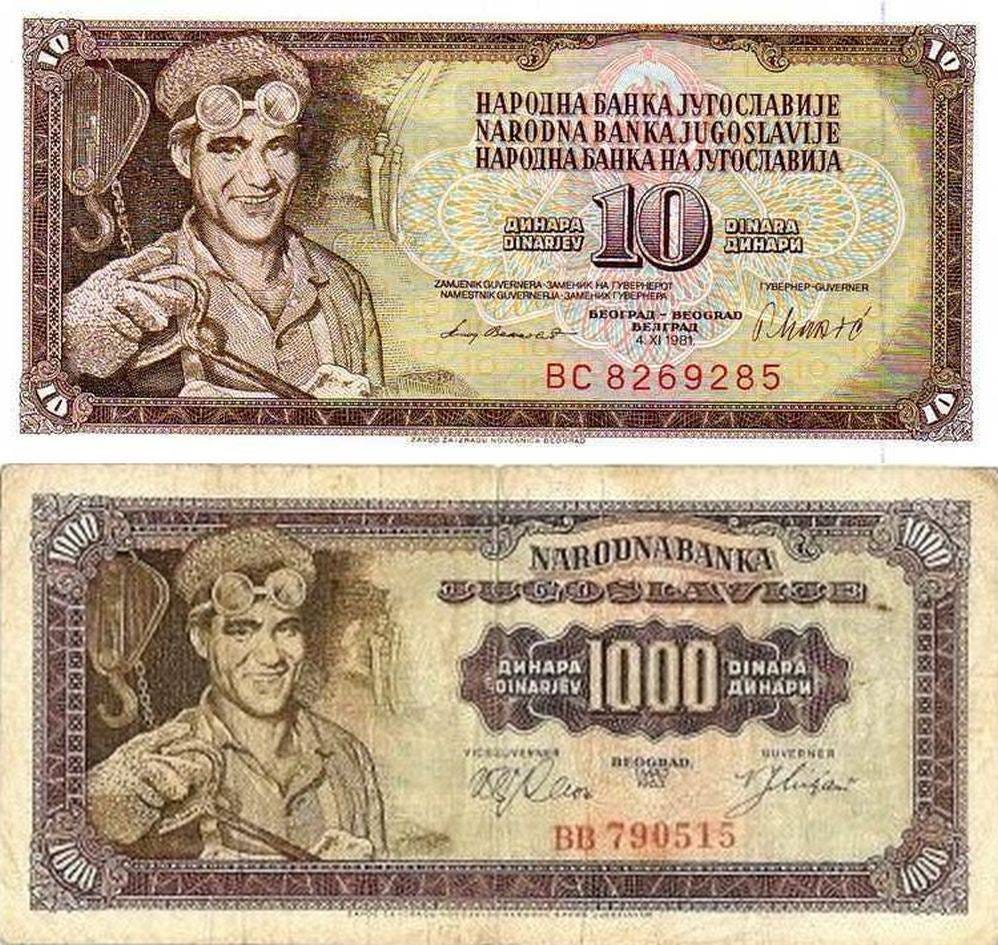
Arif Heralić? Well, not even ex-Yugoslavs would be able to put a face to that name, but they all certainly know his face. Particularly for those born before 1980, they all saw him daily smiling whenever they paid for something, for Heralić was on a Yugoslav dinar note – the 1000 one to start off with in 1955, and then the 10 dinar note following devaluation in 1965. There’s no Yugoslav who didn’t have him in their wallets or purses, or stuffed as savings under bed mattresses from Triglav to Vardar.
But while most Yugoslavs are very familiar with the face, probably second only in ubiquity to Tito back in the day, if you were to show his face to them and ask what his name is, most will say that it’s hero miner Alija Sirotanović. The reality is that the Yugoslav collective consciousness has had its wires crossed in a case of (deliberate) mistaken identity for someone else who also appeared on Yugoslav money but at a much later and briefer time.
Still, the stories for the people behind these faces on Yugoslav money show two different fates of living in socialist Yugoslavia, and often with elements that massively contradicted the ideology and optimism their images symbolised.
Most countries tend to feature notable individuals on their banknotes, often drawing from prominent historical figures. In contrast, communist states, including Yugoslavia, were founded on the idea of being “dictatorships of the proletariat” and their propaganda followed suit by emphasising the workers and peasants as the true leaders and heroes of society. As a result, members of these groups were often honoured on national currency. Since all these “people’s democracies” imposed what effectively was a Stalinist Soviet template, with its strong economic focus on heavy industry and the related use of imagery (such as smokestacks) as symbols of strength and progress, industrial workers in particular were elevated in this heroic narrative. It’s therefore not surprising that Yugoslavia’s most widely used banknote featured one such figure: the blast furnace worker Arif Heralić.
But who was Arif Heralić and what happened to him?
Arif Heralić was born on 5 May 1922 to a poor Muslim Roma family in Magljaj, Bosnia. During the Second World War, the Ustasha (Nazi-allied Croats), who conducted their own Holocaust of the region’s Roma, Serbs and Jewish people, murdered over fifty members of Heralić’s extended family, including his father and brothers in his presence. After the liberation of Bosnia under the rule of Tito’s communists, holocaust survivors such as Heralić were given precedence to opportunities unthinkable under the previous system. Since 1892, his adopted hometown of Zenica had been the site of a huge steelworks, which were to be expanded as part of Yugoslavia’s initial five-year plan focusing on heavy industry. This was to provide plenty of jobs for many, Heralić included.
At the end of 1954, Nikola Bibić, a photo-reporter from the main Yugoslav newspaper Borba took a photo of Heralić for an article about the Zenica Ironworks. Heralić was not only a model udarnik (“shock worker”) who had won medals and awards for his many achievements but also represented the success of Yugoslav communism bringing the lowest of the low to the top. Heralić certainly ticked all the boxes of disadvantage: Roma, poor, Holocaust survivor, Muslim background, no education. It also helped that Heralić was very photogenic.
The image of the smiling worker reached the heads of the central Yugoslav institute for banknote design, who in 1955 decided that Heralić’s image would be perfect for the new 1000 Yugoslav dinar note. That would in 1965 become the 10 dinar note after hyperinflation prompted a devaluation and the lopping of two zeros. Heralić was to appear on Yugoslav banknotes until the 1980s.
However, while Heralić’s smile radiated optimism with a bright future waiting ahead for him and his fellow Yugoslavs, the reality was that this was the beginning of what ended up being a tragic life for Heralić.
In May 1967, journalist N. Cvetić decided to investigate what had happened to Heralić, so he tracked him down. The interview Cvetić had with Heralić was later published in the magazine Nedeljna Revija. It’s best that Heralić talk about his life in his own words, so here’s a translation of the interview:
The life of Arif Heralić, one of the best workers at the Zenica Ironworks, began to change the moment he became aware his image was to be held in the hands of millions of Yugoslavs every day...
Arif Heralić is not a happy man. The smile that every Yugoslav knows has disappeared from his face. The man whose image is on the 1000 old and 10 new dinar banknote has changed. His eyes are downcast and framed by wrinkles and dark circles. His cheeks are swollen. His beard is grey and unshaven. Long, tangled hair... age, a chaotic life and alcohol have taken their toll.
It’s hard to recognise Arif...
The former hero worker at the Zenica Ironworks is now a pensioner. He lives in a dilapidated building in the Prvi Maj neighborhood of Zenica. His house has hardly any possessions in it, and plaster is peeling off the walls. When I was at his place, there were empty bottles on the floor amongst crumbs of dried-up bread.
We chatted for some time. Arif was sitting on a rickety ottoman because there was no chair. He didn’t mince his words. He recalled the great times he had that were now forever gone. He was one of the best workers at the ironworks. For his extraordinary efforts, he was awarded the Order of Labour 1st class and 2nd class, as well as a medal.
“Twelve years ago, they took pictures of me. When the banknote entered circulation, I actually had a heart attack. Then word spread that I had received two million dinars (US$666,666) for appearing on the bank note, so one night some people came round and almost beat the death out of me and stole 150,000 dinars (US$500) from me...”
Heralić’s life took a different turn the moment he became aware that millions of people were going to hold a banknote with his photo on it in their hands every day. He said that a strange feeling had came over him; his head went fuzzy, and so he turned to rakija to make sense of his thoughts… but that didn’t help. The demise of this hero worker from Furnace Number 3 is now littered with bottles.
He retired six years ago. This is what he has say about it now:
“I could’ve worked for another 20 years, if not more. But, well, I didn’t feel like I could do it anymore...”
Heralić receives a pension of 240 dinars (US$20) – that’s 24 notes with him on it, and 190 dinars (US$15) in child allowance. That’s not a lot for so many mouths.
How many children do you have, Arif?
“Ten, exactly. I also have a wife... and children. Wait... I have eleven children!”
What does Arif Heralić do? What does he do now that he’s not working?
“I once read how some woman had her picture taken and they put that picture of her on the cover of the book, but they didn’t want to pay her. The woman sued and won millions. My picture has been printed on millions of notes, and so, I want money for that too. I’ve tried pleading my case everywhere I can but nothing has come from that. If nothing else happens, I’ll take this to the International Court of Justice in the Hague. I know that the rich are rich. I’ll go to the United Nations if I have to...”
Why do you drink so much? That’s not good for you...
“I know it’s not. But, well... I’ve been treated twice at the psychiatric hospital in Sokolac. They say I had some depression in my head. I was also taking disulfiram (a medication to treat alcoholism – ed.) and something else. For what it’s worth... I have a doctor there who keeps me in check. But I don’t touch those medications anyone. I’m all right.”
Let me take your photo.
“And what are you going to give me for it?”
I will send you a copy of the photo.
“Well, don’t take my picture then.”
He then asked for 600 dinars. After that, he immediately sent his son Jasmin off to get him rakija from the nearby kafana. That’s how we parted. Arif was there beside the bottle...

As mentioned in the interview, Heralić tried through the courts to receive compensation for appearing on the banknotes; however, the Yugoslav courts ruled that it wasn’t a photo of him on the banknotes but a drawing, therefore cancelling any chance of reimbursement. Evidence was also presented in court that he had signed away the use of his likeness for a symbolic sum of money.
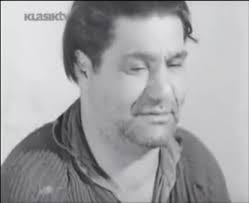
Also in 1967, Vojdrag Berčić filmed an interview he had with Heralić for his controversial documentary Devalvacija jednog osmijeha (Devaluation of a Smile). Heralić was just as candid about his fate on film as in his interview for Nedeljna Revija. He admitted that he’d drink on average half a litre of rakija a day!
TV Zagreb bravely broadcast the film about the exploited and rejected labor hero, causing a huge scandal. As Heralić’s actual life story ran counter to the image of happy workers and positivity perpetuated by the Yugoslav communist authorities, TV Zagreb later had to apologise to viewers for broadcasting the film, describing it as a “political and programming error”, and the station’s programming editor was forced to resign.
Heralić died in abject poverty and penniless on 16 June 1971, aged 49. He had 12 children in the end, but only seven survived to school age.
The following day, Večernji Novosti, a Belgrade newspaper, had this to report on Heralić’s death:
“Yesterday in Zenica, after a long illness, Arif Heralić, a worker at the Zenica ironworks and shock worker, whose image appears on the 10-dinar banknote, died. He worked hard at the ironworks and fell ill a few years ago. That’s why he retired.”
That’s it.
Fast-forward to now and the image of Heralić can still be seen… just not on notes or as regularly as before, but on Yugonostalgia-related souvenirs ranging from mugs to t-shirts. As for royalties?
So who then is Alija Sirotanović, the name most Yugoslavs erroneously attribute to Arif Heralić’s likeness?
Sirotanovic’s image on currency first appeared on the new 20,000 Yugoslav dinar banknote released on May Day 1987; however, it was only in circulation for a couple of years after having lost much of its value from hyperinflation and eventually replaced on 1 January 1990 with a new convertible dinar as part of the monetary reforms ushered in by Ante Marković, Yugoslavia’s last prime minister.
Unlike Heralić, Alija Sirotanović was not a blast furnace worker but a famous miner. The mix-up in names is colloquially attributed to the images of both workers on their respective banknotes being similar in terms of face and worker’s helmet, but I’ll let you decide – here are the banknotes: Heralić up top, Sirotanović below. Do they look the same to you?
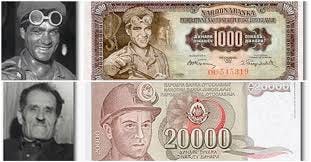
Alija Sirotanović was a miner from the town of Breza, 25 kms north of Sarajevo, and became a star hero worker and the stuff of legend. Sirotanović was thrusted into the limelight when on 24 July 1949 at the Kreka lignite mine near Tuzla, northeast Bosnia, he broke the world record in coal mining, digging a staggering 152 tonnes with his brigade in eight hours. This record surpassed that previous set by the first Soviet shock brigade miner Alexei Stakhanov by as much as 50 tonnes. What made this even more audacious was that it happened at the height of animosity between Tito and Stalin following their ideological split in 1948, so a Yugoslav breaking this Soviet record was more a case of one-upmanship than anything else.
While Arif Heralić’s image was far more famous, the anecdotes from the life and times of Alija Sirotanović were, let’s just say, far more cheerful and politically suitable for propaganda purposes, especially in light of what had happened to Heralić in the final years of his life. Mixing the two workers was then a deliberate ploy. And this remains to this day. Despite many references correctly stating otherwise, whether it be on the net or in articles in newspapers and news portals throughout ex-Yugoslavia, just a quick internet search for “Alija Sirotanović” will bring up many images of Heralić instead.
A plethora of legends and anecdotes grew around hero worker Sirotanović, primarily designed to provide the masses a shining example of what the ideal Yugoslav citizen should be like – hardworking, humble and happy with his lot. The most famous Sirotanović anecdote goes like this: allegedly, during a grandiose visit by Tito to the mine, Sirotanović “complained” to the Marshal about the conditions at the mine by saying “I need a bigger shovel to work better”. Even though his primary mining tool was a pneumatic drill rather than a shovel, legend also has it that this bigger shovel, christened the Sirotanovićka, was actually made for Sirotanović. It was twice the size of the other shovels in the mine and by using it Sirotanović was able to break even more records in coal mining.
Sirotanović refused the new apartment offered to him in his hometown of Breza and instead had it reassigned to a family with no permanent address. When Tito offered Sirotanović the car of his choice, the miner insisted on a modest Zastava 750 aka Fićo, Yugoslavia’s version of the Fiat 500. He never seeked to progress in his career and remained an ordinary miner until he retired in the mid-1970s. His humble life continued in retirement, during which he lived off of his average pension in relative obscurity. His granddaughter said in an interview for the Croatian magazine Arena that when Tito died, her grandfather cried for three days nonstop.
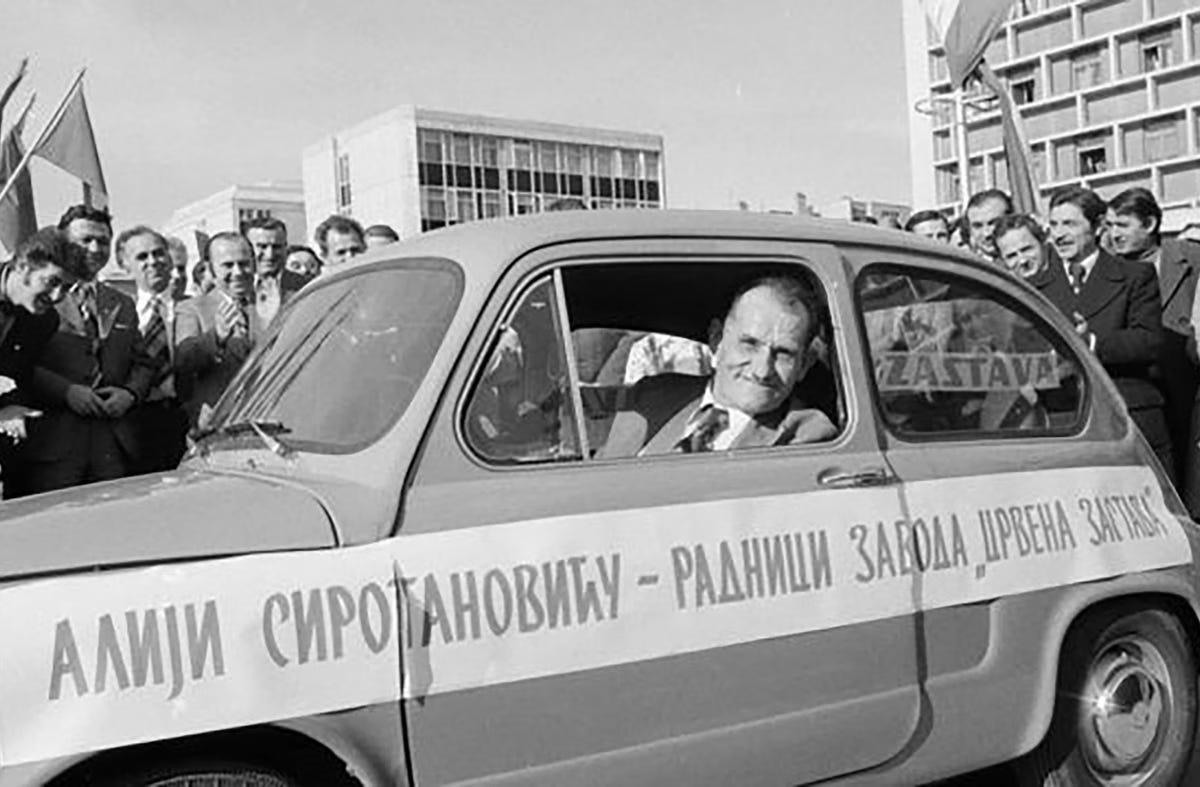
All seven Sirotanović brothers and most of their sons were also miners. Alija’s nephew Arif, the son of his brother Ahmed who had died in a mining accident in 1970, founded an association in honour of his uncle – Alija Sirotanović and his comrades – to continue the spirit of the family’s dedication to hard work. Today, a street in Breza bears the name of Alija Sirotanović, and his bust stands in the vicinity of the town’s mine.
The legend surrounding Alija Sirotanović was even the inspiration for the satirical song Srce, ruke i lopata (“Heart, Hands and a Shovel”) by legendary Sarajevo rock band Zabranjeno Pušenje on the band’s 1987 album. The band was astute enough not to reference Alija directly, but instead the hero miner in the song is “their neighbour Avdija”.
Sirotanović died in May 1990, which was rather symbolic given that Yugoslavia, the country in which he was one of its headliners, at the time was in its deathknell.
In many ways, the figures chosen for socialist Yugoslavia’s banknotes, and more so what their images represented, trace the arc of the state itself: Arif Heralić embodied the optimism of a country rebuilding from the ruins of war and an era defined by drive, industry and a genuine belief in a collective future. By contrast, Alija Sirotanović eventually came to be the anachronistic symbol of a later time, when that early optimism had long faded and the system was straining under its own contradictions. The fact the back-stories of the two were deliberately conflated also reflects the approach underlying where socialist Yugoslavia go it wrong – rather than face the grim reality, take responsibility and do something tangible about the situation, the easier way out was to stage-manage everything. Together, these banknote heroes are not only Yugoslav icons but also markers of the country’s journey – from a hopeful ascent to an uneasy twilight that would, too quickly, give way to the violent conflicts of the 1990s.









.jpg)











.jpg)






.jpg)









_logo.svg.webp)



_(52052470251)_(cropped).jpg)









.jpg)













_(8249451687).jpg)