Head spun! 🤯
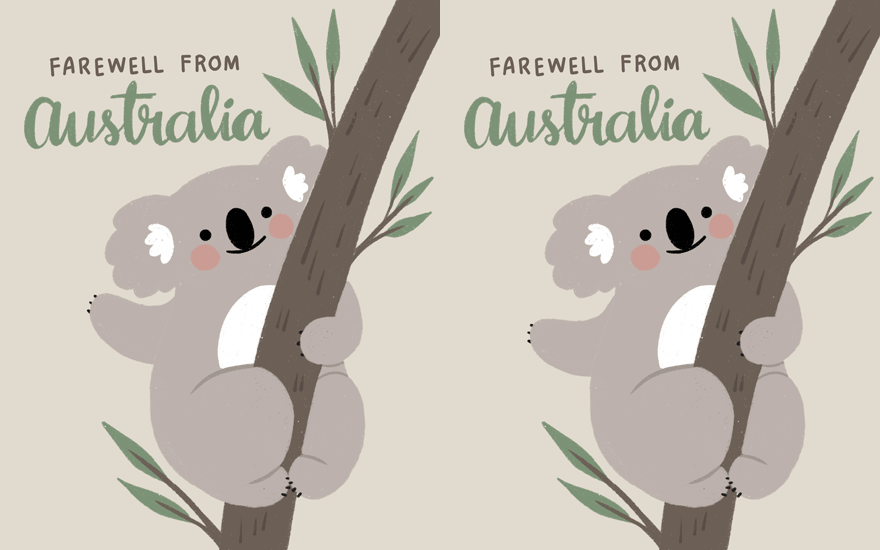
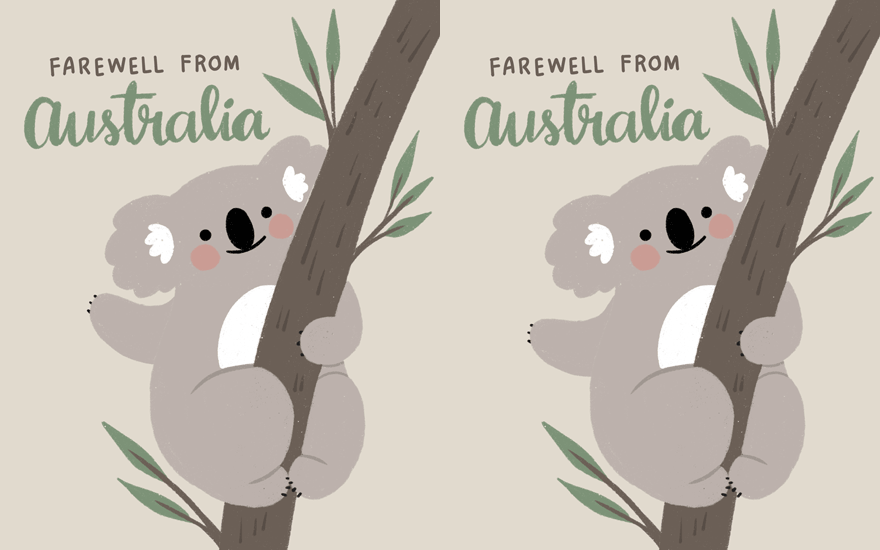
The other day I found out that the transitive verb “to farewell [someone]” is uniquely Australian.
Yes, really!
Mignon Fogarty aka Grammar Girl, one of the most famous grammarians on the net, recently asked whether Australians actually use “farewell” as a verb, because in North America they definitely don’t.
And I can confirm: Aussies absolutely do!
In Australian English, “to farewell [someone]” means to say goodbye to someone for a long time in a meaningful, emotional or ceremonial way. So you’d farewell a work colleague who’s starting a new job elsewhere but you wouldn’t farewell that colleague if they’re just popping out to the shops.
Essentially, it’s the Aussie equivalent of the rather formal “to bid farewell” – just that we drop the “bid” (how on-brand for us!).
Example:
We farewelled Bruce from work today as he’s moving to Canada start a new life as a ski instructor.
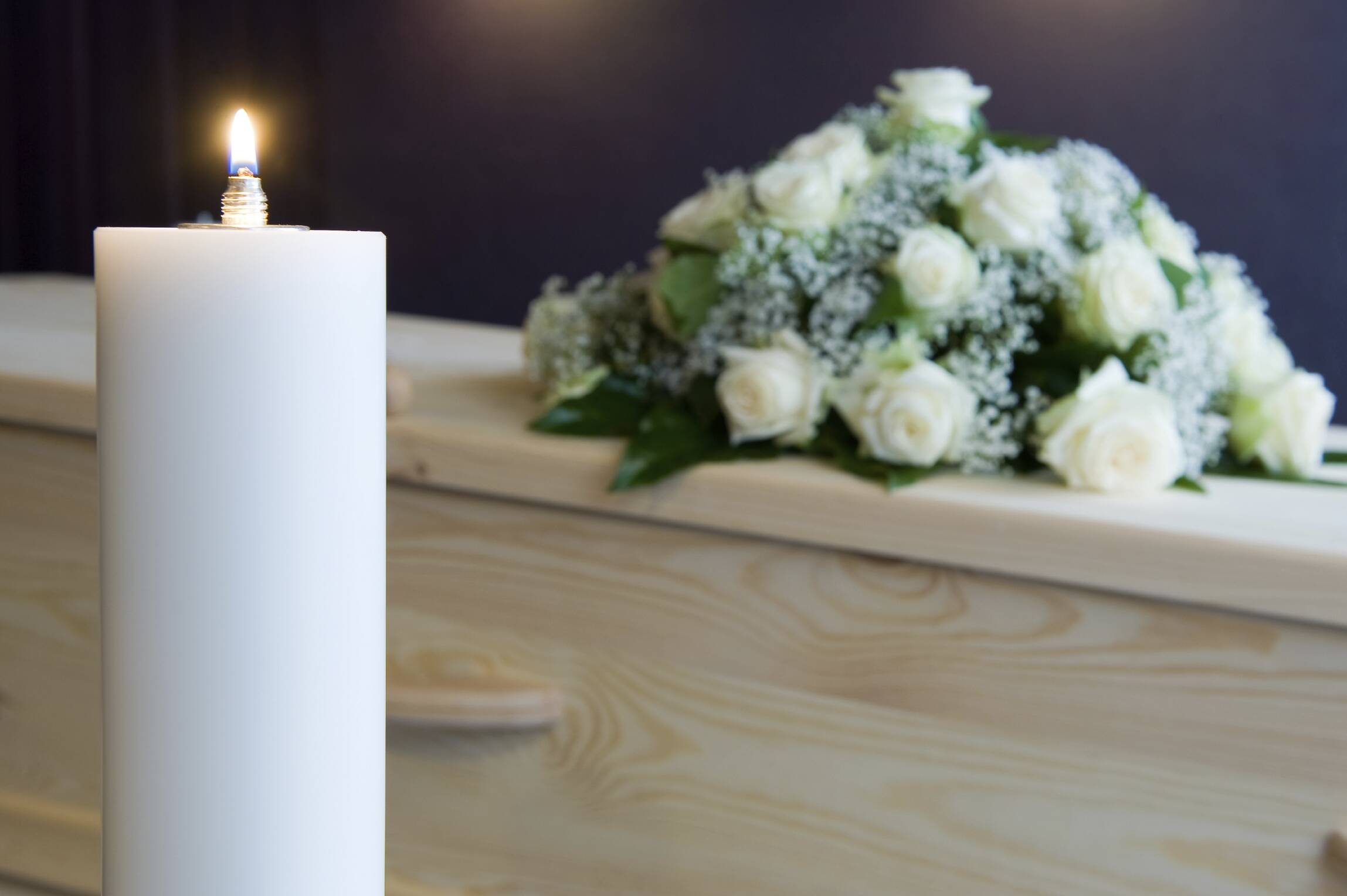
Australians also farewell someone when they die. Again, it’s the same sentiment as before in that this farewell also has a meaningful, emotional and/or ceremonial element to it. So it’s common when someone dies to read or hear this in the Australian media:
Today we farewell a great Aussie hero!
But it doesn’t end there. Australians use another “farewell” when someone dies, just that it’s from Latin:
Vale
Now here it’s not the poetic word for “valley” – though Australia certainly has its fair share of places with “vale” in their name, such as the world-famous wine region of McLaren Vale in my home state of South Australia.🍷
In many parts of the world, including Australia, you’ll see: RIP [Name]
But in Australia, you’ll more often see: Vale [Name]
For example, here’s the AFL website with its farewell to iconic Australian Football commentator Dennis Commetti, who died earlier this month. And legendary Sydney drag queen Maxi Shield, who unfortunately died of cancer in February this year.
You'll also see Aussies use “vale” like this in social media comments.
Interestingly, “vale” only became mainstream in Australia after the death of former Prime Minister Gough Whitlam in 2014. Prior to then, “vale” would only be used in this context primarily in university-related texts (particularly alumni correspondence) and community or social club newsletters when announcing the death of a prominent former member. Since then though, it has become a distinctly Australian way to mark someone's passing – respectful and, above all, non-religious.
So what makes “vale” non-religious? This is a topic of much debate on social media sites such as Reddit and Facebook.
“RIP” is only half the phrase, which in full is “rest in peace and rise in glory”, so explicitly Christian in its implication of an afterlife. Now that doesn’t fit well in modern Australian society, where according to the 2021 census 38.9% of Australians have no religion.
And how do Aussies pronounce “vale”?
Well, strictly speaking it's “va-ley”... but you'll get a few Kath & Kim types pronouncing it like “veil”. OK, I admit that I have at times unwittingly said “veil” instead of “valé”.
Now this doesn’t mean that all Australians have adopted usage of “vale”. As what one fellow Aussie commented when I originally posted this on social media:
“As an Aussie who hasn't lived in Australia since the early 2000s, this linguistic quirk is actually quite annoying to me. Not because I don't get the sentiment, but it comes across to me as insincere. As in, it is the equivalent of someone just writing RIP without any other sentiment. I find both equally lacking in sincerity.
And when used by Australian media outlets who target international audiences, it shows a lack of understanding of language and cultural nuance.
I am sure that if I had been living in Australia when it gained traction, my thoughts would be different, but from an outside in perspective, it has had this impact on me.”
Considering Latin terms in English are usually the sole domain of public school toffs in the UK (think Boris Johnson and co), Brits in particular find the Australian usage of “vale” intriguing. An English friend of mine asked whether this Australian “vale” is then bookended by its counterpart, “ave”. Just as “RIP” has been replaced with “vale”, imagine if birth announcements instead of beginning “We're delighted to welcome to the world little baby Prunus Minimus...”, simply read “Ave Prunus Minimus” (insert alternative name as appropriate).
Sorry to say, Aussies haven’t reached that level as yet, but who knows what can happen. Hey, let’s make “ave” happen! But then again, with my Aussie sunnies (sunglasses) on, “ave” reminds me of that classic Australian joined word “avagooodweekend” (“have a good weekend”), which for years was the main slogan in ads for the insect repellant Aeroguard.
For more about the origin of “vale”, check out this witty interaction Q&A on the Australian Writers’ Centre site.
Language evolves, cultures adapt and sometimes even a borrowed Latin word becomes part of national identity.
Discovering what makes Australian English unique has been and will be an ongoing journey for me. Just when I least suspect it, I find out something new. The quirks are endless – and that’s exactly what makes all languages, and not just Australian English, so fascinating.
To make sure you don't farewell your Australian clients forever, best to have your text and copy checked by a dinky-di Aussie who knows his stuff – me! Email me at info@nicknasev.com for more info.






.jpg)


.jpg)



























.jpg)







.jpg)














_logo.svg.webp)






_(52052470251)_(cropped).jpg)










.jpg)
















_(8249451687).jpg)