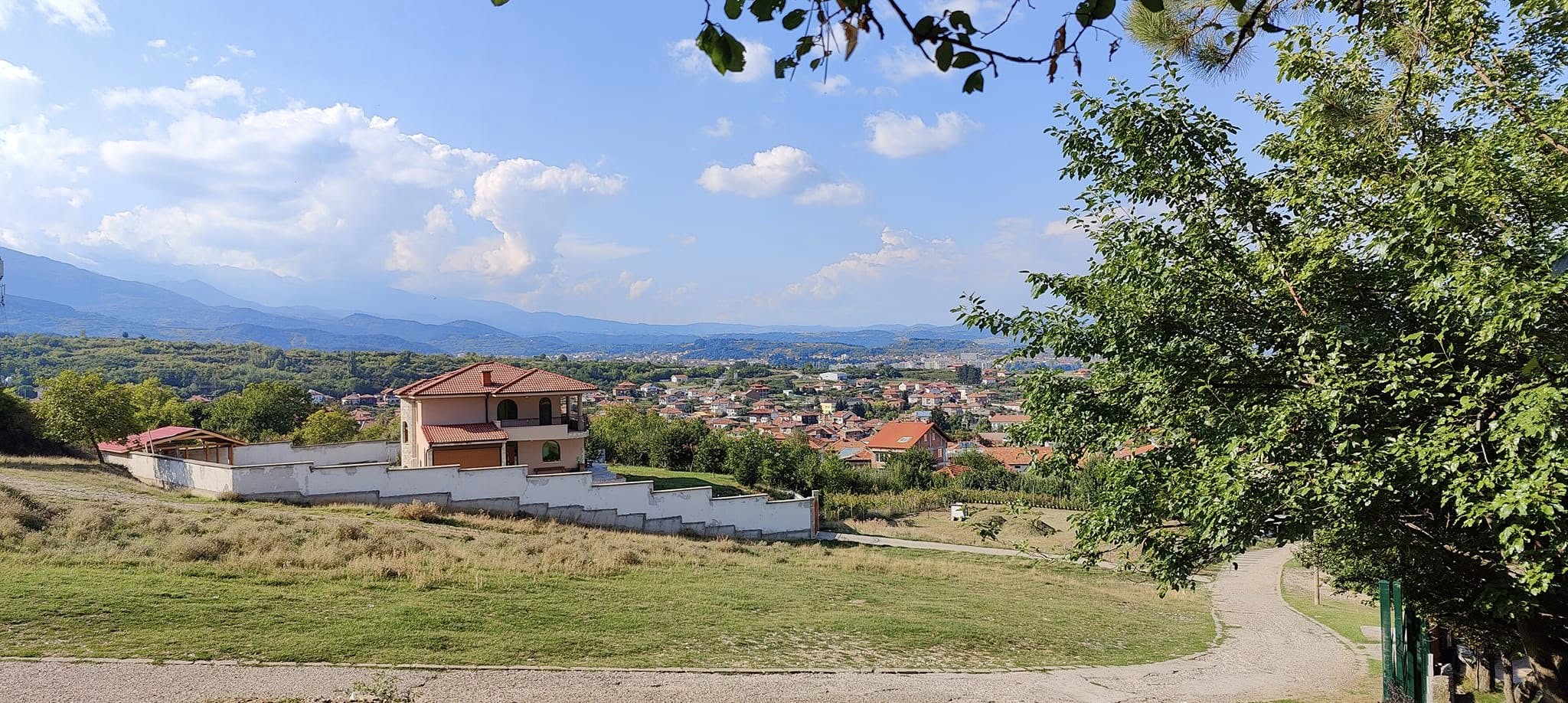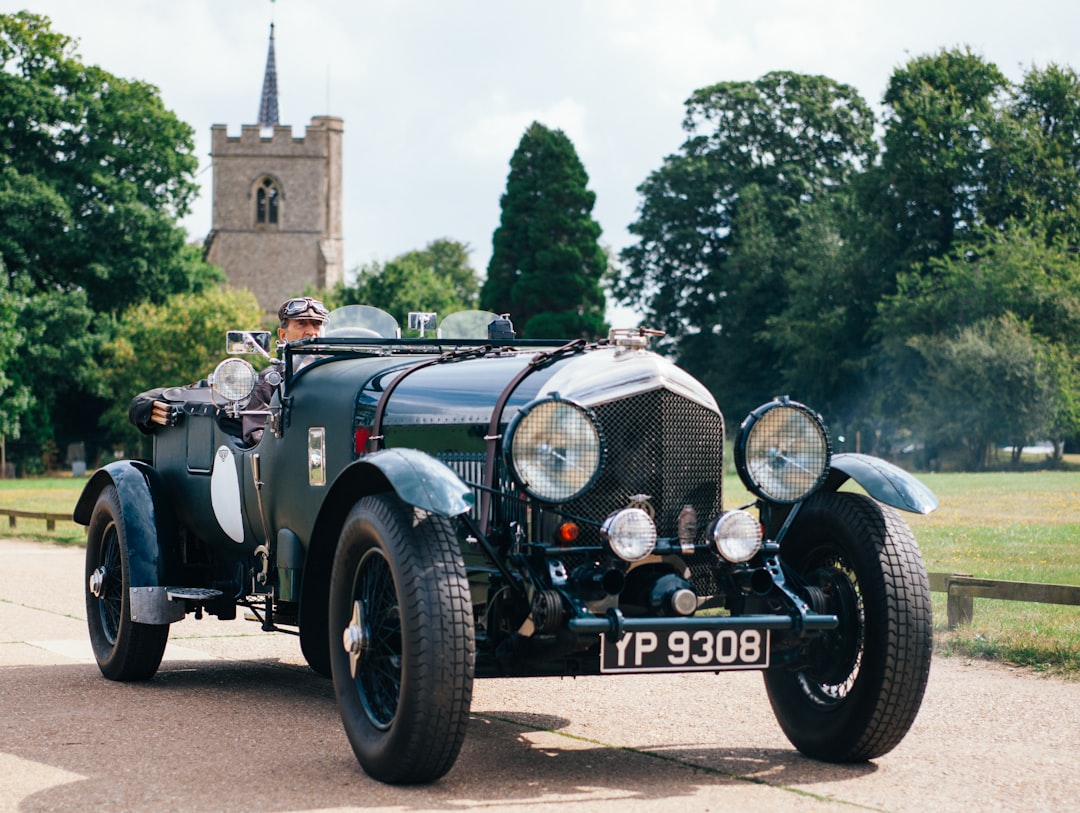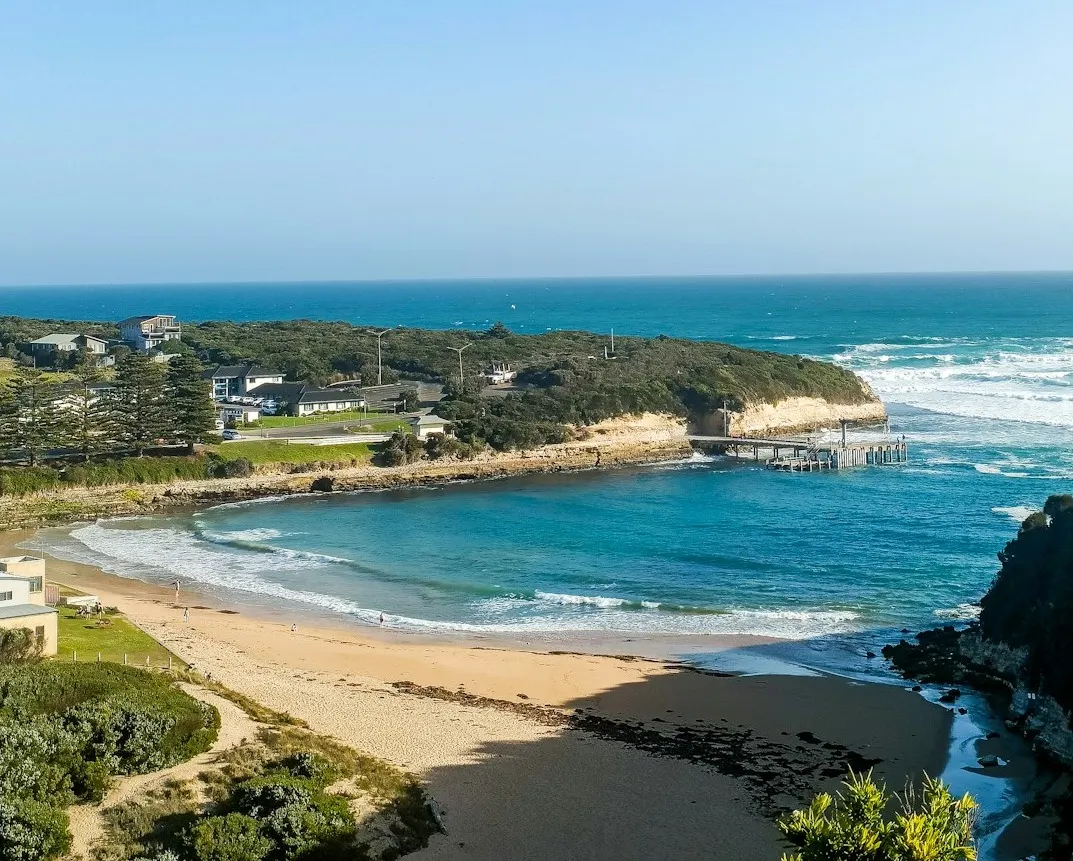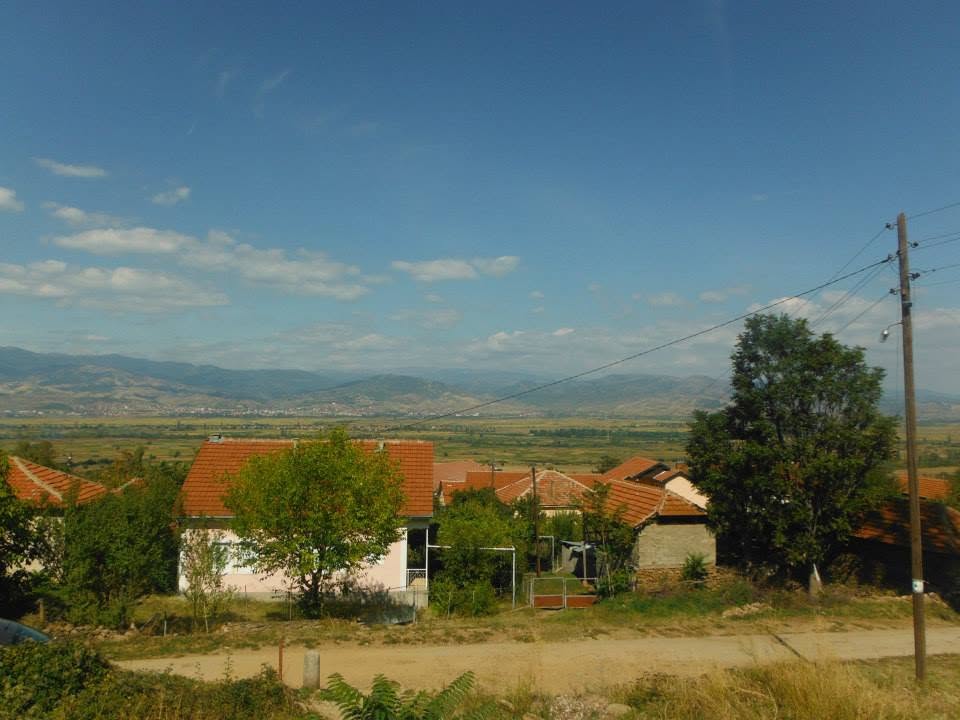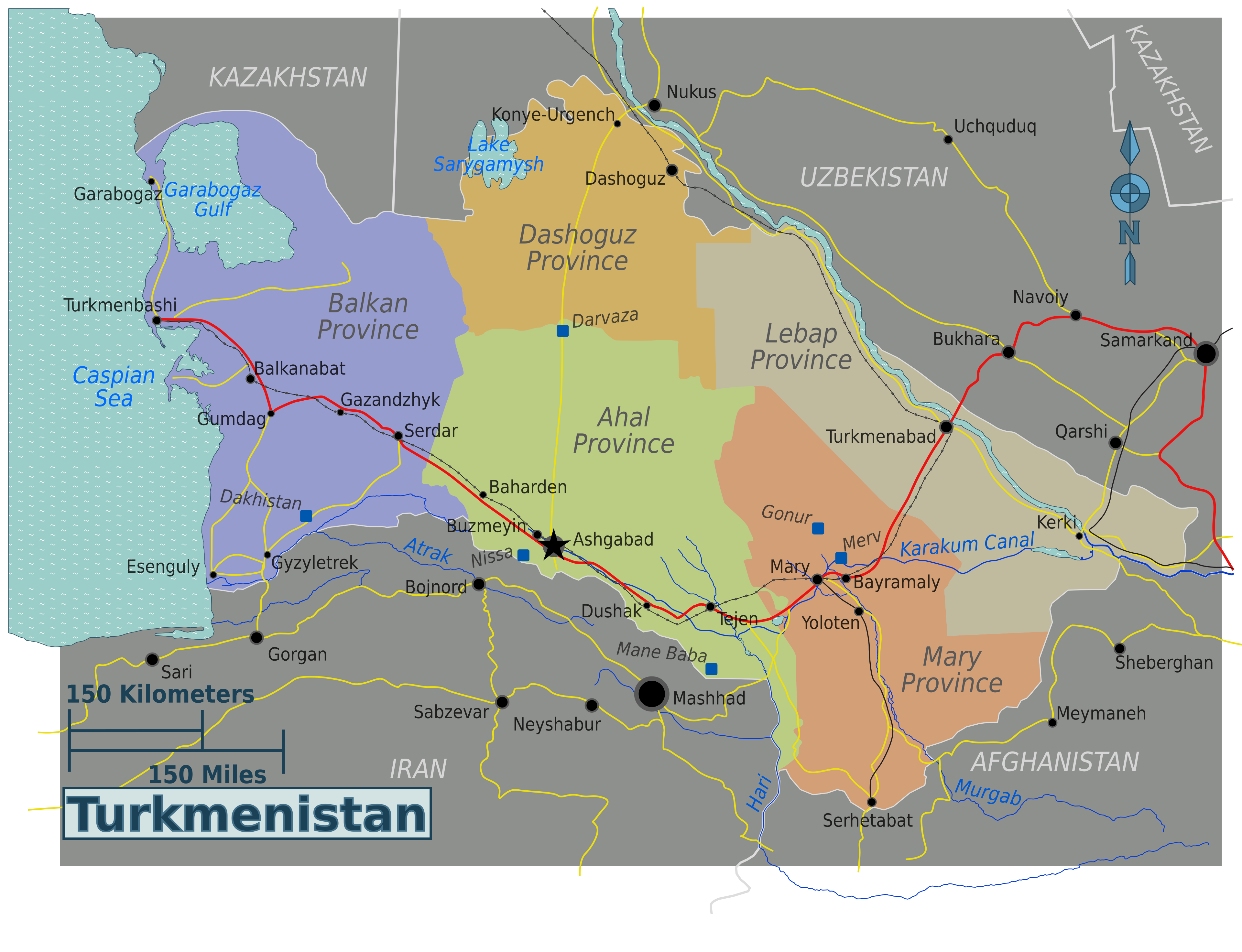
A vilayet (“province” in Arabic/Turkish) named after the mountain range in its centre, with place names such as Ilidzha, Doyran and Kazandzhik, a curious mix of Turkic and Slavic influence, previously under Communist rule, and where there are still many Ladas traversing its pot-holed roads. This important crossroads also attracts visitors worldwide for its spectacular natural beauty and now developed coastline.
Of course I’m talking about the Balkans… but not the one you’re probably thinking of. Welcome to Balkan Welaýeti, the western province of Turkmenistan in Central Asia, on the shores of the Caspian Sea. Did you know that such a place exists?
So how come there are two places called “Balkan”? And is there any common root to their names or is it just an extraordinary coincidence?
Like with so many terms, no-one really knows for certain what’s the origin of the word Balkan. Some say that it may be related to the Turkish word bālk meaning “mud” (from Proto-Turkic *bal “mud, clay; thick or gluey substance” and also the Turkic bal meaning “honey”), and the Turkish suffix -an meaning “swampy forest”. However, while the mud certainly fits for Turkmenistan’s Balkan, there are no signs of any swampy forest here – the province is predominantly dry desert.
There’s another theory, primarily advanced by Russian experts, suggesting the word Balkan might be derived from the Persian بالاخانه (bālākhāneh), comprising of bālā (بالا) meaning “above”, “upper” or “top” and khāneh (خانه) meaning “house”, “room” or “building”. This “-hane/-hana” ending is common in Persian and Turkic languages, and subsequently in some European Balkan languages, in words for public premises. For instance, “meyhane/mehana/meana” (taverna) is formed from mey meaning “wine” and hane meaning “house”, hence literally “winehouse”. Balakhaneh therefore is “big high house” or “upper house”. Interestingly, some claim the English word balcony, which came from the Italian balcone, also originates from balakhaneh, making it a cognate with Balkan. But the jury is still out on that one.
In any case, Balkan eventually came to mean “mountain range” in Ottoman Turkish, and this word with this meaning is still used in some dialects of languages in the Balkan peninsula (notably in Bulgaria). It was this general descriptor, attributed to its use by local interpreters, that was later adopted as the name for what otherwise is southeastern Europe.
Now some would point out that the Balkans are named after the mountain range that starts from southeastern Serbia and cuts across the centre of Bulgaria, but to locals this mountain range is known as Stara planina, lit. “The old mountain range”.
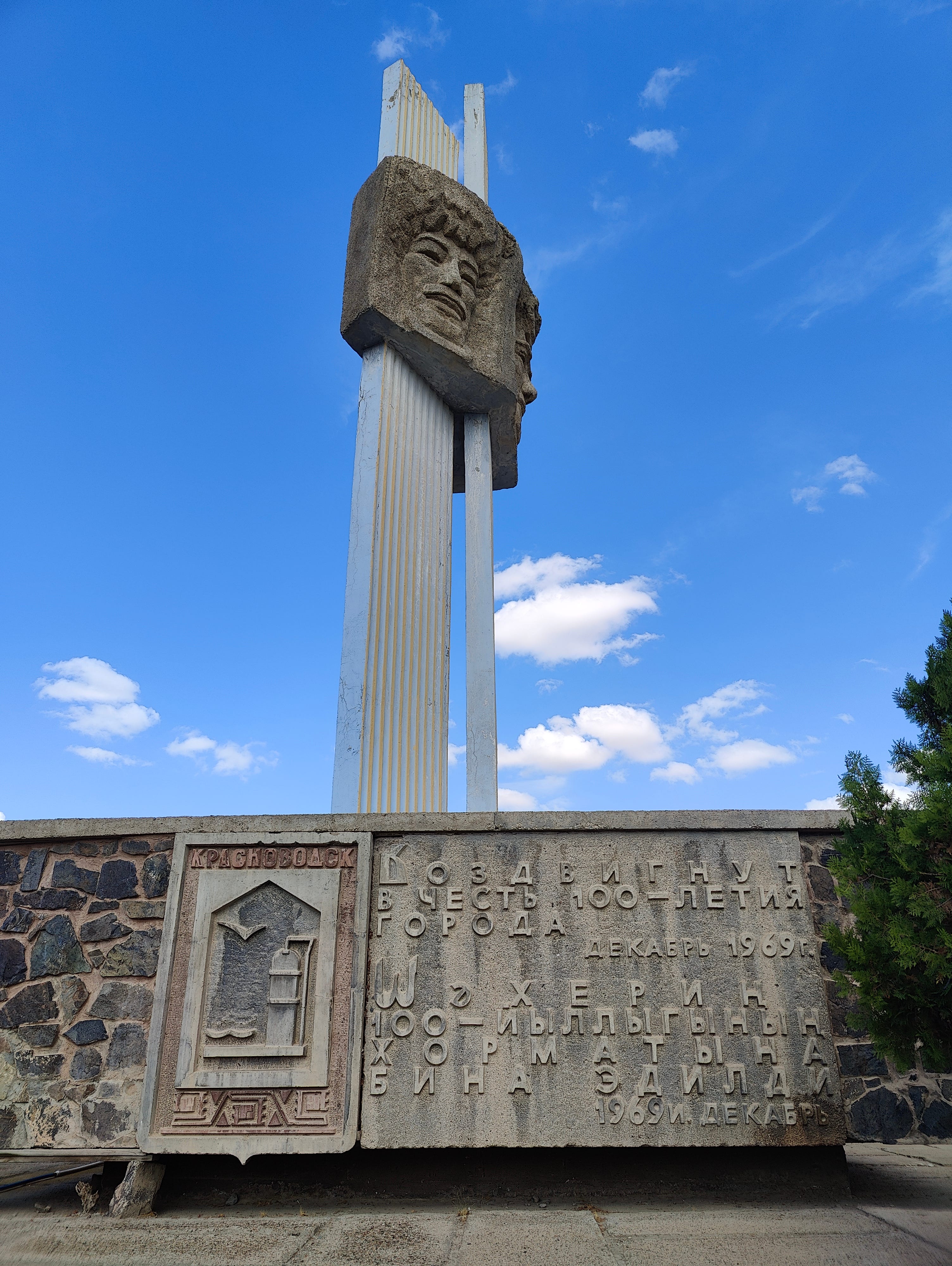
That there are two regions in the world called Balkan is, officially anyway, a relatively new thing. Balkan province in Turkmenistan during Soviet times was named Krasnovodsk Oblast, after its former capital. As for the Balkan mountains in Turkmenistan, the Russians called them Balkhan, pronounced “Bal-han”. Now this is not how the local Turkmen called them – they’ve always said Balkan. The Russians though decided to distinguish the mountains in Turkmenistan from the region in southeastern Europe by simply changing the k in the former to kh. The Russians have form in doing this – the ethnic Kazakhs call themselves “Qazaq” i.e. “Kazak”, meaning “nomad”, but coming from the same Turkic root, that too is how you say “Cossack” in Russian. So as not to get anyone confused, the Russians applied the same formula and changed the final k for the Turkic ethnic group to become Kazakh (i.e. pronounced Kazah). Since becoming an independent country, the Kazakhs have attempt to rectify this by officially renaming the country Kazakstan or (somewhat cumbersomely for English) Qazaqstan, but it never took hold – probably because there’s already a difference in English between “Cossacks” and “Kazakhs”.
All clear? Oňat!
Travelling to the other Balkans was part of a wider trip to Turkmenistan, the country (in)famous in the west for its eccentric leaders and their “bizarre” and “weird” proclamations (banning gold teeth, changing the names of months, cult of personality, etc.). I had already been to the other four former Soviet Central Asian “stans”, so I was curious to get to Turkmenistan. To go there, you need to book with an officially registered guide (usually as part of a group), who will provide a letter of invitation, and then pay for a rather expensive visa. This system is very much unchanged since the time Turkmenistan was a part of the USSR when all tourism was controlled under the juggernaut that was Intourist. This continuation of Soviet practice was very indicative of much (not all though) of how modern-day Turkmenistan functions. One of our guides beamed with pride when he told our group how in the 1990s Turkmenistan did not go through the shock therapy, and the resulting destitution and chaos it caused in almost all of the rest of the former USSR and Eastern Bloc. The Soviet system is still then very much intact, just now updated with new, overtly Turkmen window-dressing.
Our trip started with a few days seeing the sights around the showcase capital of Ashgabat with its record-breaking 500+ marble-clad and often peculiar buildings, and an overnight stay at the internationally famous Darvaza gas crater (I had no idea it was such a bucket-list destination!). Next stop on the itinerary – the Balkans.
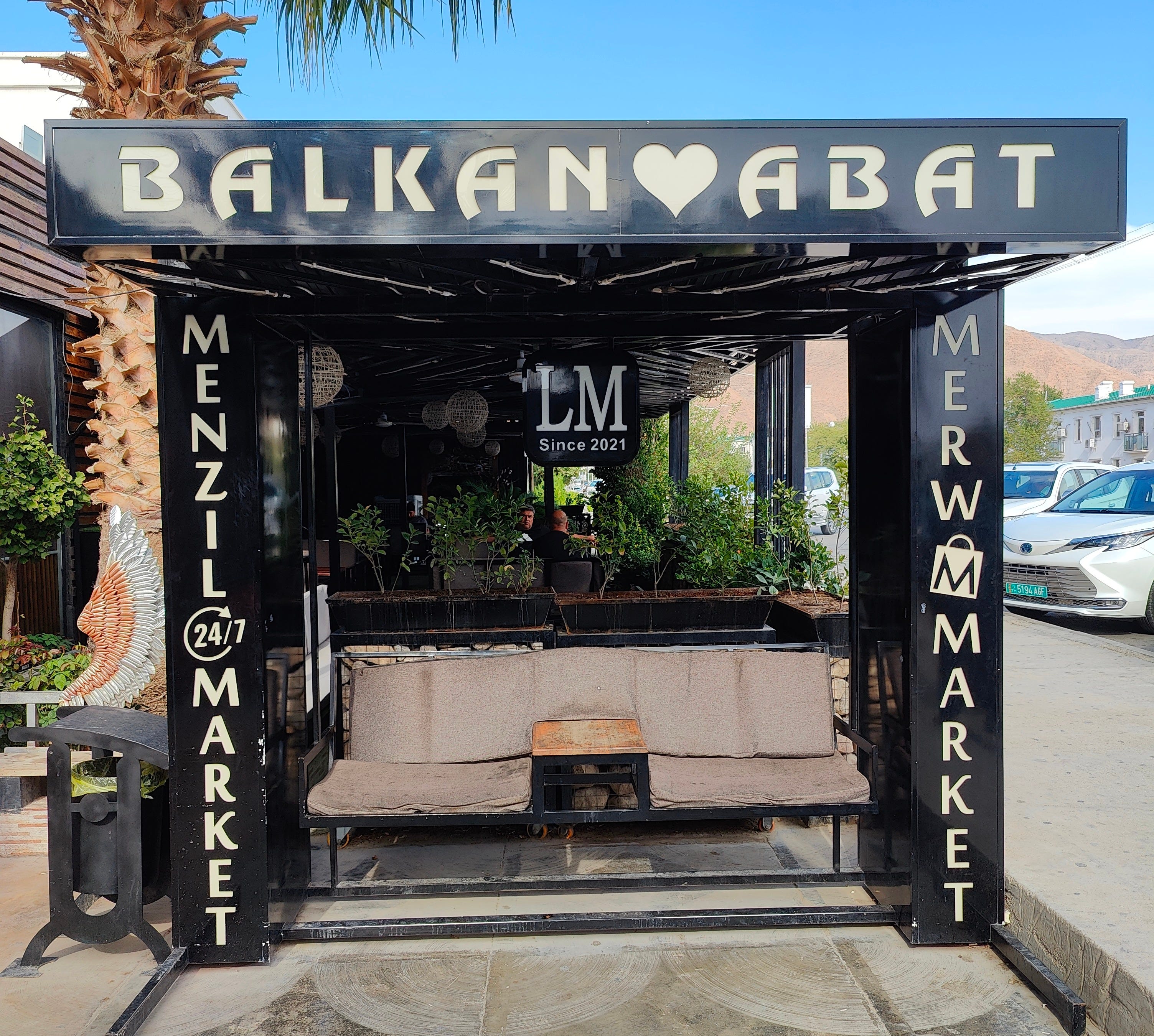
Our driver Valerii took us on the four-hour drive on the relatively good road (we only caught one major pothole – Valerii apologised to us for the bone-shattering impact) that goes to the province’s capital Balkanabat (“Balkan City”), formerly Nebit-Dag, and ultimately to Türkmenbaşy, formerly Krasnovodsk, Turkmenistan’s main port city. This vital artery spans the narrow stretch of Turkmenistan’s precious little arable land – Turkmenistan is otherwise 80% desert. For the journey, Valerii was telling me of his amazing life story, having had an illustrious military career spanning back to the days of the Soviet Red Army. He had met his wife, a Turkmen woman and mathematics professor, when they were both studying at university in his native Donbass, Ukraine. Now his wife, his adult children and grandchildren all live in Texas. I asked him how come he wasn’t with them (he had a Green Card and lived in the USA for a while). Valerii didn’t like life in the US suburbs and missed Turkmenistan too much, so he decided to move back. His main pastime is fishing, which I found a bit surprising given dry Turkmenistan is not exactly a place teeming with watercourses – its main water source and lifeline is the Karakum canal, a hero project built during Soviet times. Feeding this canal with water redirected from the mighty Amu-Darya river, though providing Turkmenistan with much needed irrigation to expand agriculture, was one of the main factors that led to the nearby Aral Sea to dry up. Valerii told me the canal and its branches are teeming with fish, and so that’s where he’s to be found on most days – give him a fishing rod, some homemade vodka (samogon i.e. “rocket fuel”) and a quiet spot by the canal and he’s happy. So why would a guy like him, with a distinguished military background and a keen angler, be wanting to drive a group of westerners to remote parts of his adopted country? “Well, it’s better than just sitting around at home”, he said. Besides, one of the assigned drivers had called in sick at the last minute, so Valerii was doing this as a favour for the commander of the driving team. And for most people in Turkmenistan, there’s no reason for them to go into the desert anymore, so here’s a perfect excuse to go and see some spectacular sights.
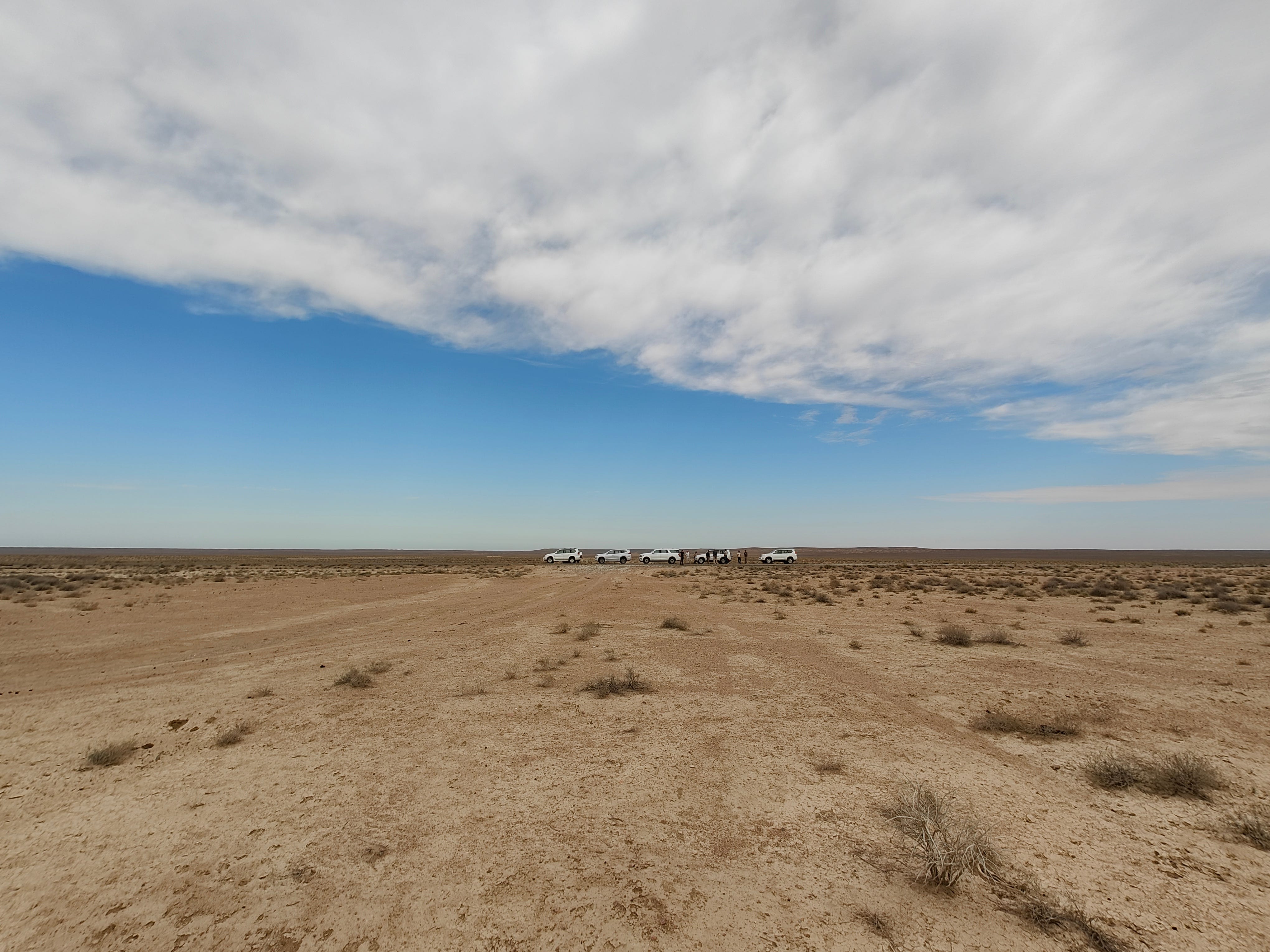
Our convoy of five beaming white 4WDs – new cars are predominantly white in Turkmenistan, not because the previous president deemed coloured cars unlucky (as claimed in the west) but because it’s more aesthetically pleasing for use in Ashgabat, being an ak şäher (“white city” as the billboards proclaim) – contrasted on the road to the surprisingly large number of well-maintained, decades-old Soviet ZIL, GAZ and KAMAZ trucks (more so than anywhere else I’ve seen in the former USSR), plus a significant amount of pristine Ladas and other Soviet-era cars of all colours. When all it takes to fix these cars is the creative use of a wire clothes hanger and some strategically applied masking tape, they’ll be driven by the cockroaches left after the nuclear apocalypse.
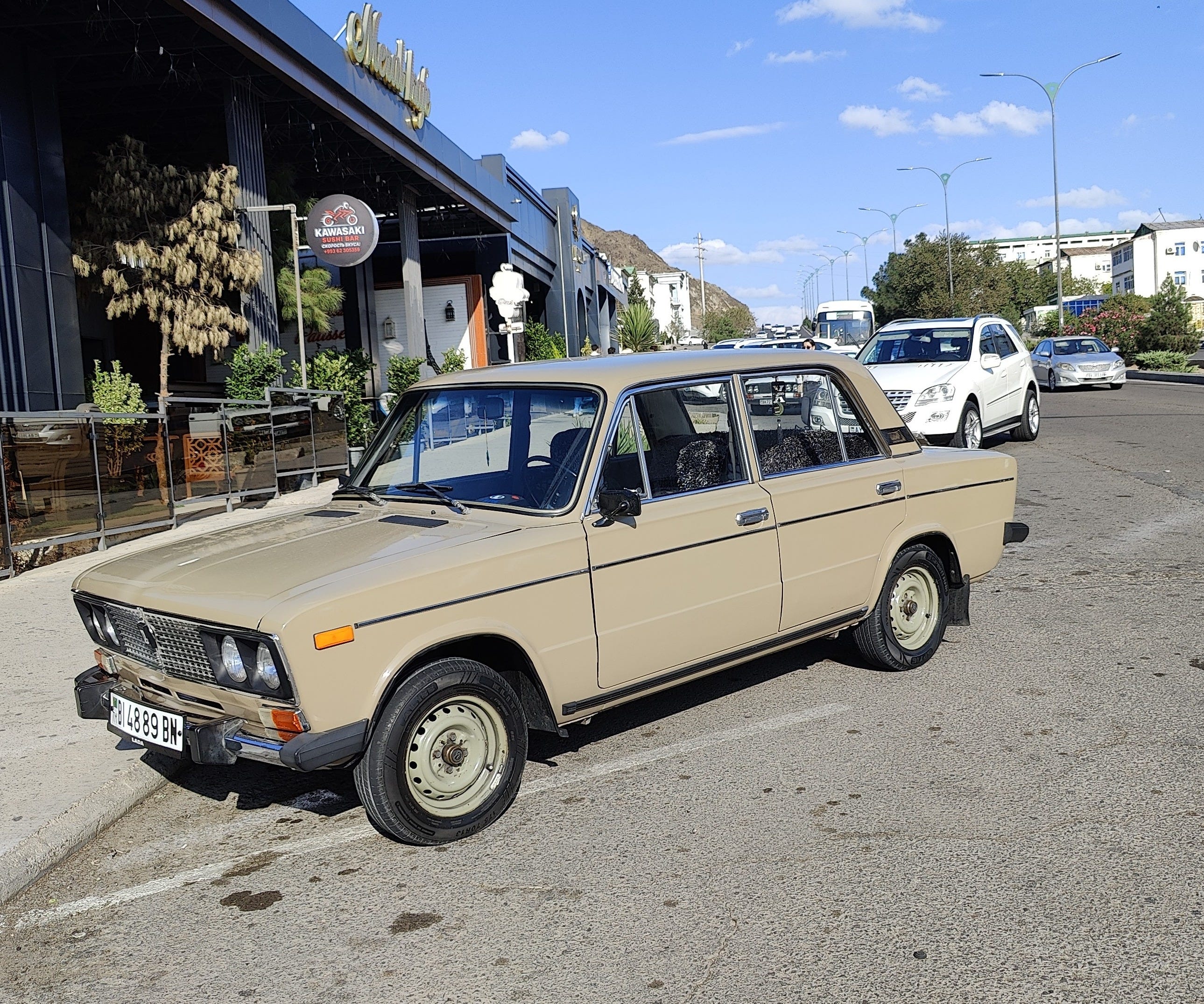
That disparity between capital and province found worldwide is particularly wide in Turkmenistan – anyone can surely see that most of Turkmenistan’s oil and gas wealth has been invested in the capital. Balkan province looked like another country – a more distinctly post-Soviet one.
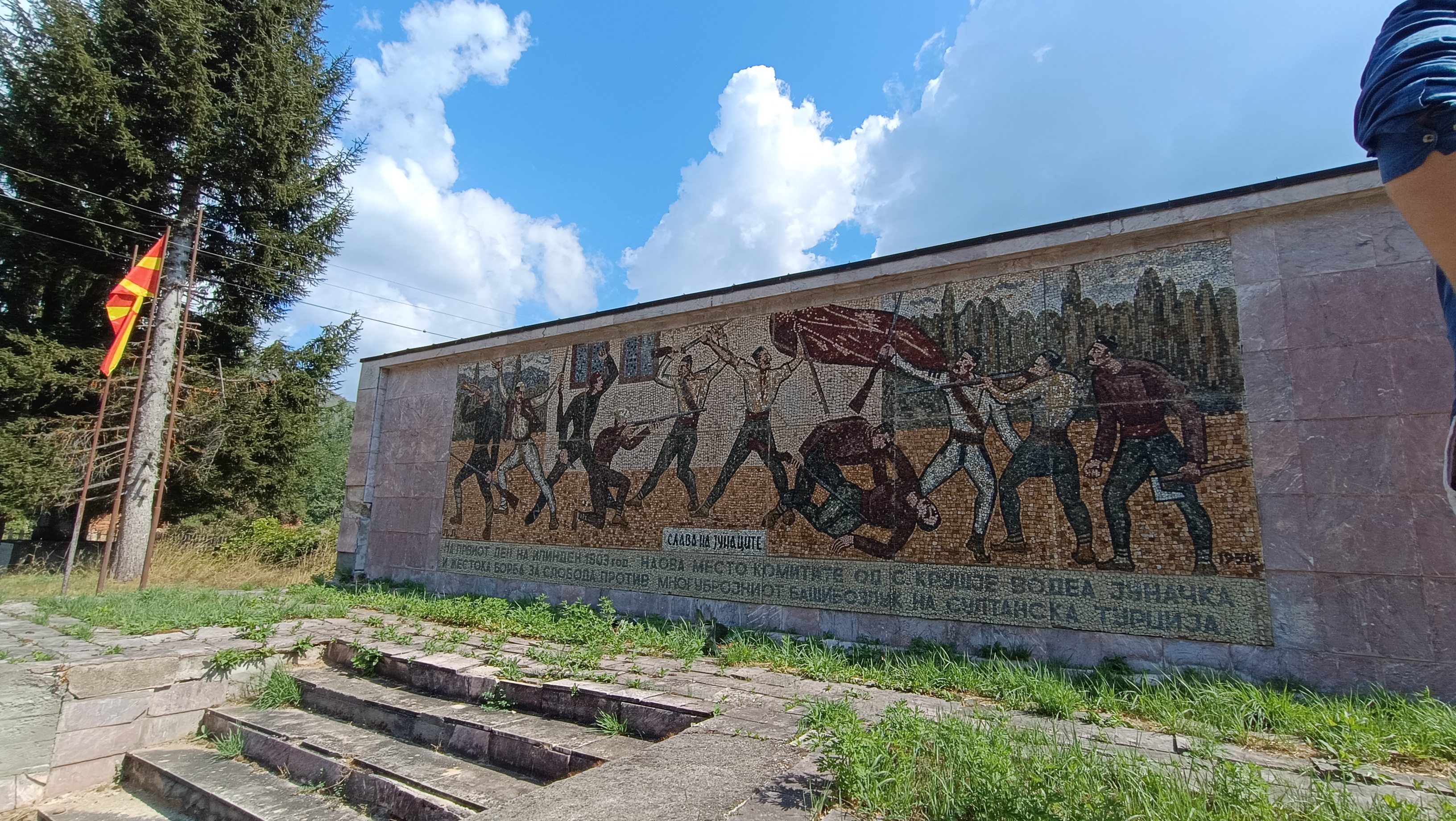
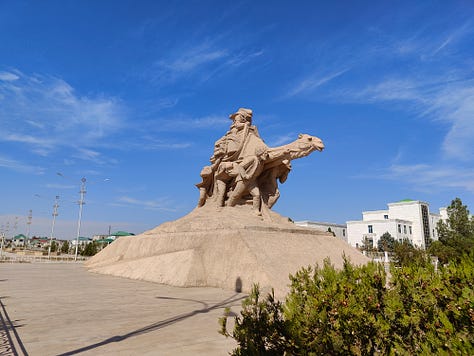
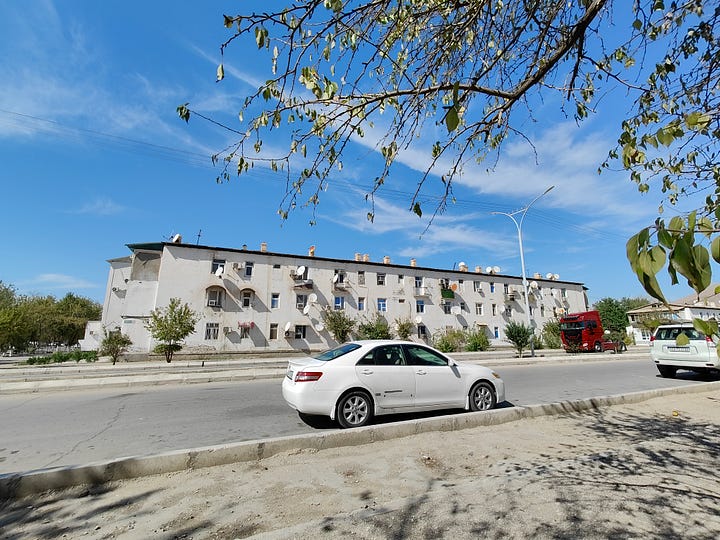
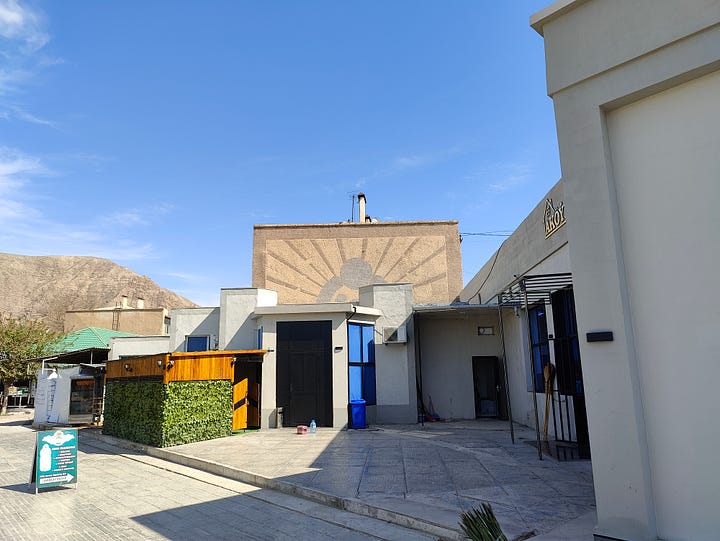
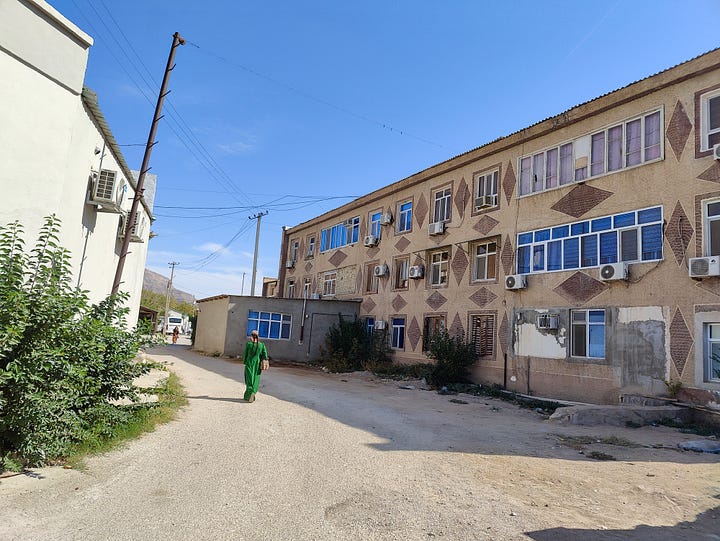
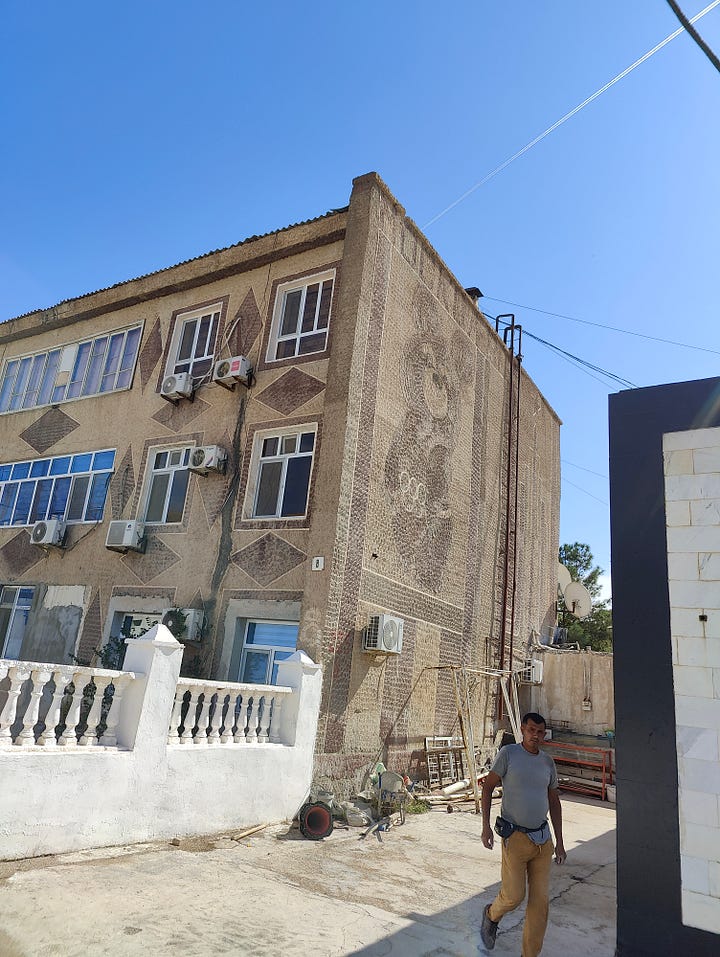
We had been warned, or better put, promised, that Balkanabat wore its Soviet past on its sleeve. Promise fulfilled – it looked very much like other “new” Soviet-era cities in Central Asia. Balkanabat's history is heavily linked to petroleum. The city was founded in 1933 during Stalin’s brutal industrialisation of the USSR as a petrol city – its original name was Neftedag, combining the Russian word neft’ meaning “oil” and dag, the Turkic/Persian word for “hill”. That name was later Turkmenified post-Stalin to Nebit-Dag, with its current, more obvious, name being adopted in 2001. First stop in Balkanabat was at the large monument at the far western end of the city, known in Russian as Первопроходцы (“Pioneers” or also called “Desert Explorers”), depicting a camel, Ivan Gubkin and his peers struggling to make their way through the unforgiving Karakum desert. Our guide emphasised the Russian vs Turkmen aspect to all these Soviet-era visual elements, such as in the giant mosaic murals on opposite sides of a building (in the pictures below). Mishka, the much-loved mascot of the 1980 Moscow Olympics was also still up and sun-kissed.
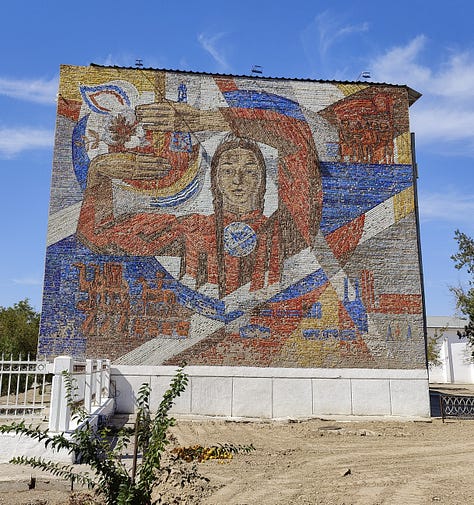
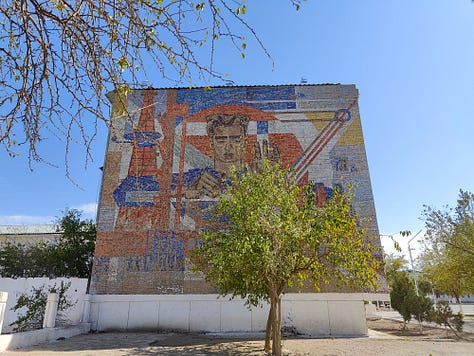
Balkanabat was supposed to be where we were going to spend the night, but our reservations for the local hotel had been cancelled the night before. Actually most of our itinerary for Balkan province was thrown out the window… and we can put the blame on one person – a certain Vladimir Vladimirovich Putin!
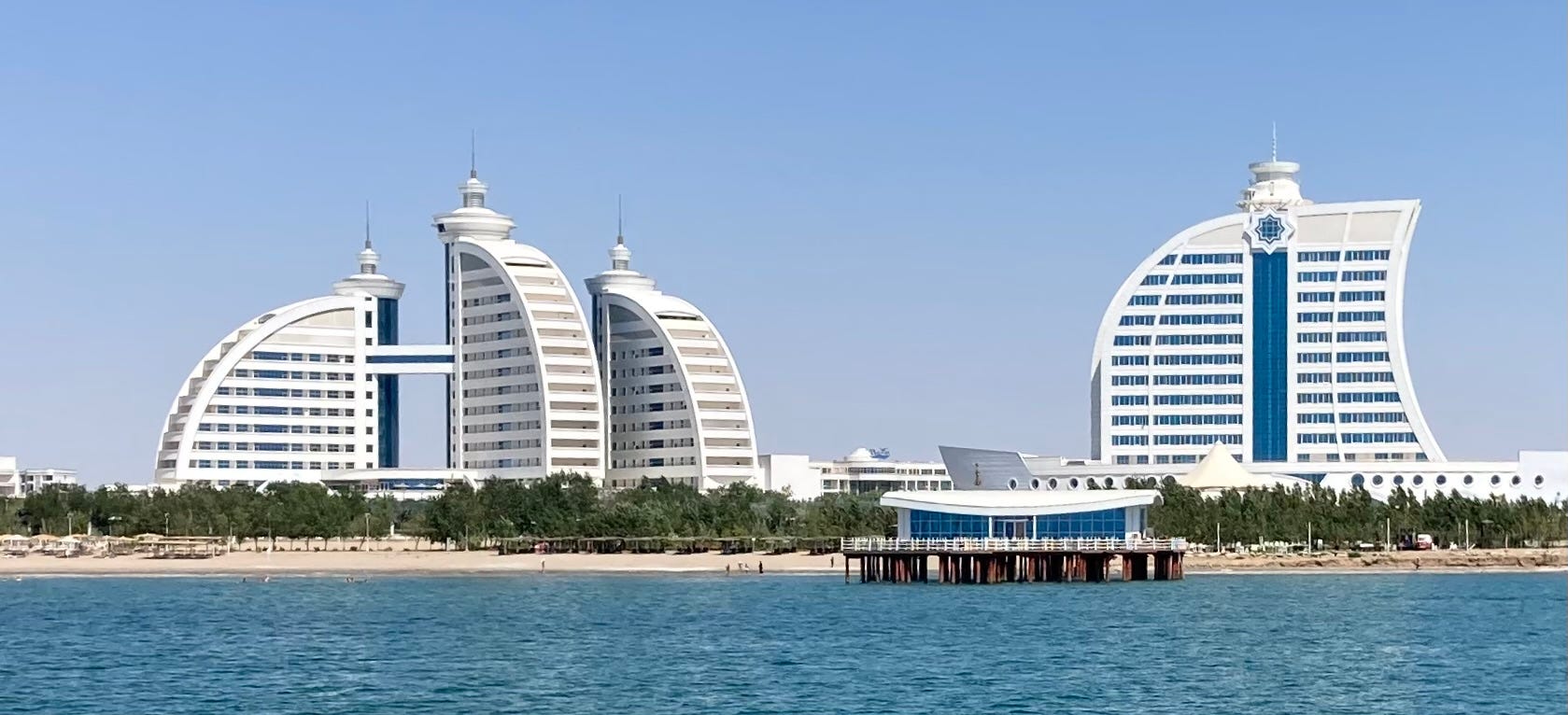
No, he hadn’t started a war or launched missiles in Balkan province. The Turkmens were just being very security-conscious as two regional summits were being held at the seaside resort zone of Awaza on the province’s Caspian sea coast. Guest of honour at these summits was Vova. Originally, we were going to stay at one of the gradiose Dubai-style hotels in Awaza, but guess where the summit was to be held. That had been cancelled a month earlier – fair enough, but how our presence in Balkanabat, a good 150 km away from Awaza, suddenly posed a problem, who knows? Best not to ask. A Plan B was quickly organised – we’ll instead be camping at the majestic Yangykala canyon. OK, so I’m not much of a camping person, and the prospect of spending another 48 hours with no shower and sleeping in the lack of comfort was not what I had in mind, but when travelling in such places, hey, why not just experience it. If Valerii can give up fishing to take us here, I can put up with camping.
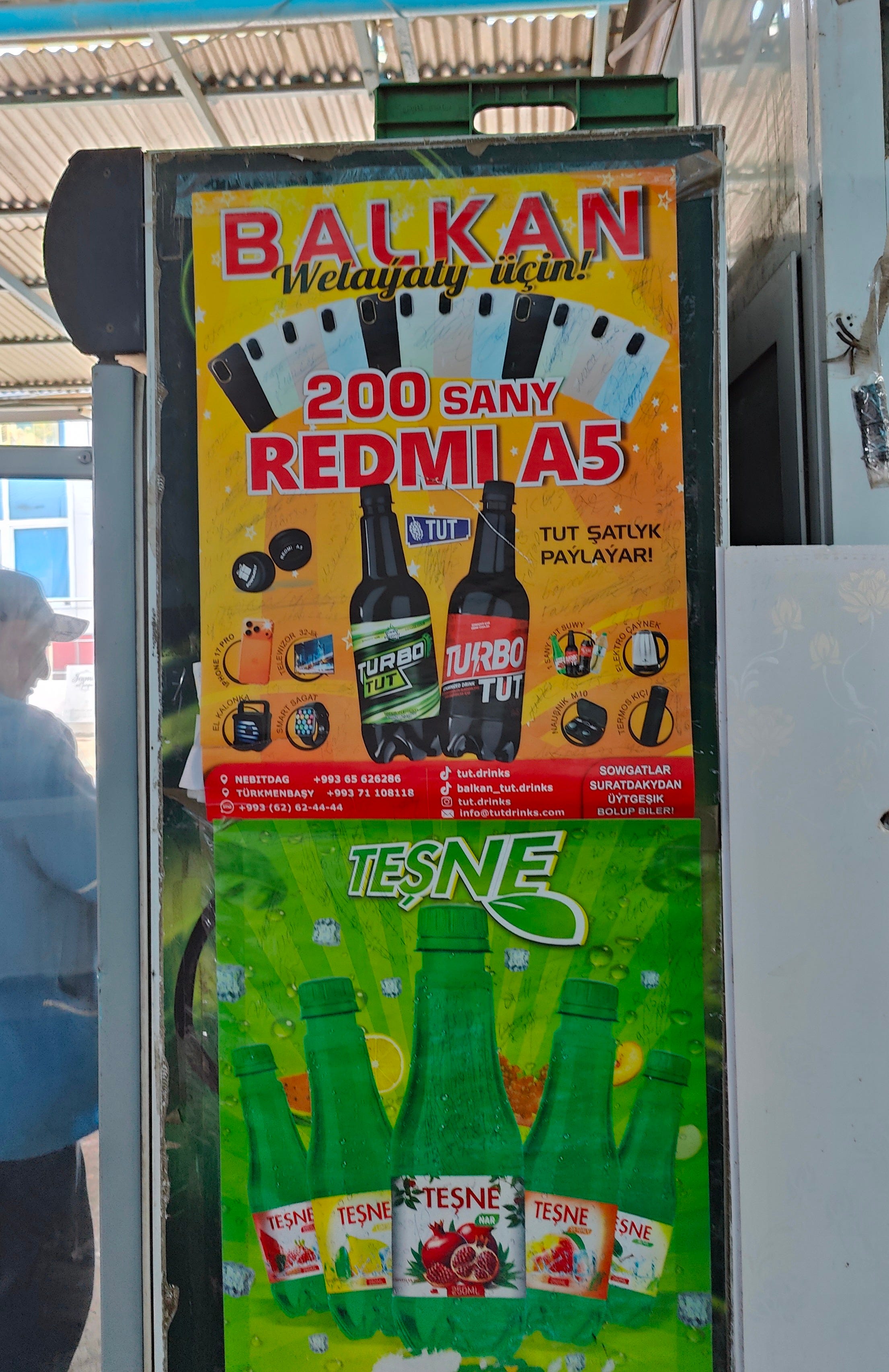
We were dropped off at the local supermarket to stock up on snacks (salty cheese balls are the go) and buy draft beer filled into 1.5 litre plastic bottles (I’ve never seen this before in a supermarket). Lunch at a local café came complete with a birthday cake and the staff attempting to sing Happy Birthday in English to one of our fellow travellers. Next, into the Balkan mountains, though unlike their European counterparts, they’re barren from the intense desert heat and devoid of lush tree cover.
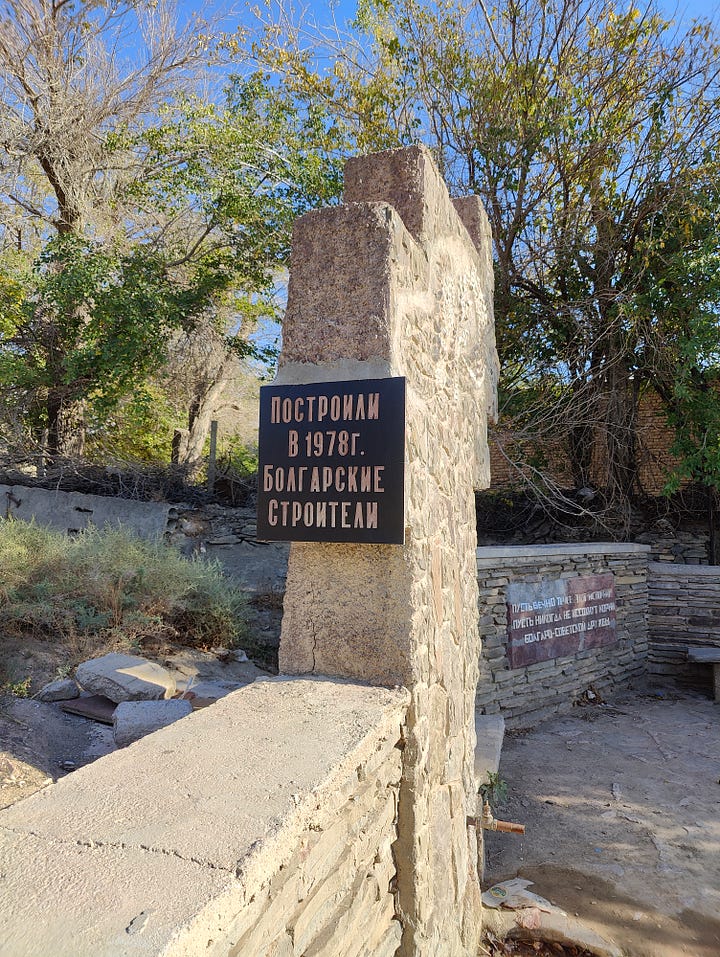
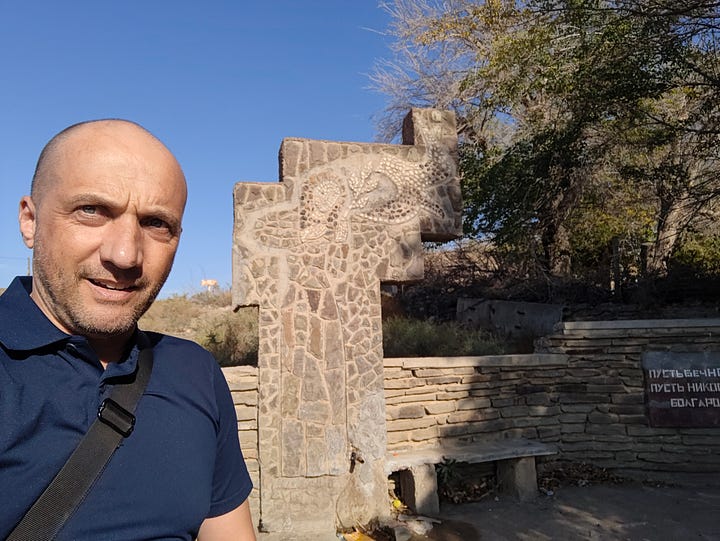
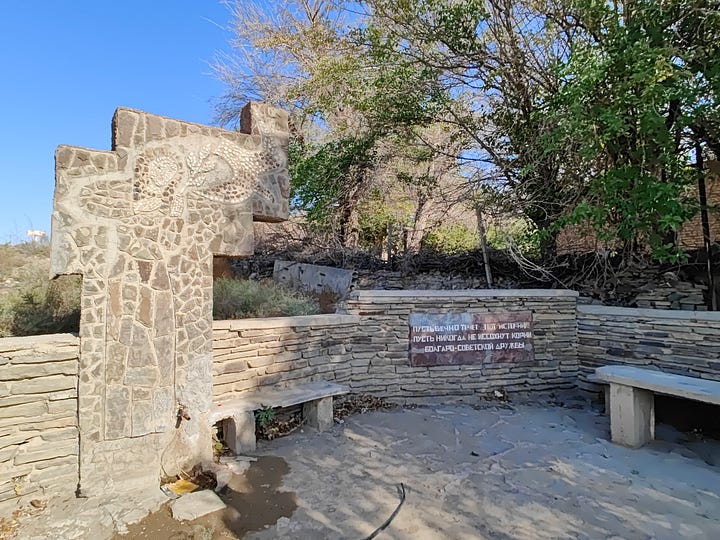
About 30 minutes into our drive through the Balkan mountains, we came to a sudden stop not far from the village of Tasharvat. Our guide, Rahym, was eager to show us a special monument from Soviet times. I wasn’t expecting much as there’s only so many T-34 tanks and Lenin statues to see until they become completely old hat. Not this one, though.
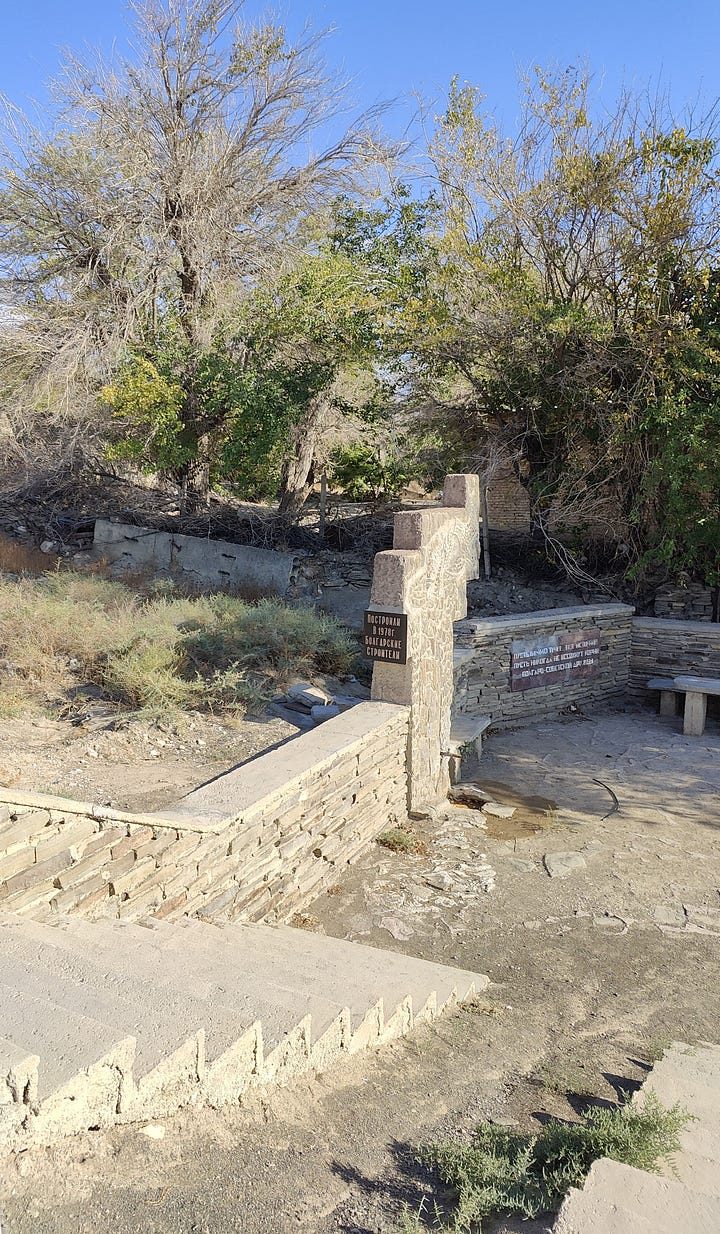
I was completely dumbstruck when I saw the sign greeting us simply stating that this monument had been made in 1978… by Bulgarian builders! It was a cheshma, a traditional public water fountain commonly seen on roadsides throughout (European) Balkan countries; the term being yet another Persian word (meaning “water spring”) that entered the Balkans via Ottoman Turkish. This cheshma featured a mosaic of a Bulgarian maiden in folk costume and a plaque lauding that constant refrain from socialist times – eternal Bulgaro-Soviet friendship. I just stood there with my mouth wide open! Seeing this was like being transported back in time. The connection here was more personal than merely a linking of geographies. My uncle had been one of those Bulgarian builders. He, like many other Bulgarian citizens, spent many years in the USSR doing backbreaking work in harsh conditions. His first assignment was cutting trees in the Komi autonomous republic in the far north of European Russia, but most of the rest of his time in the USSR was working in construction in and around Odessa, Ukraine. From what I know, he hadn’t been in this team of Bulgarian builders who had gone from one Balkan to the other. I’ll have to ask him if he knows anything about them. Still, I didn’t expect anything so blatantly Balkan like this in other Balkan.
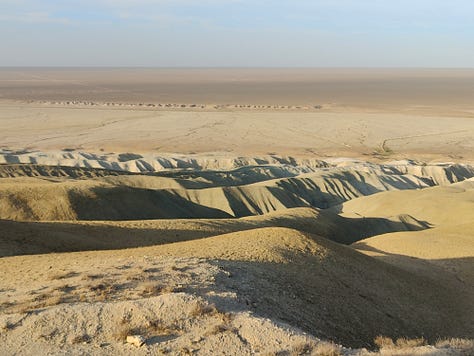
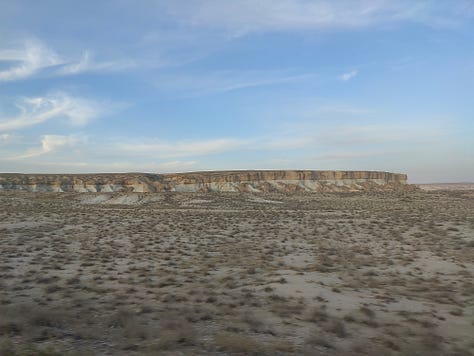
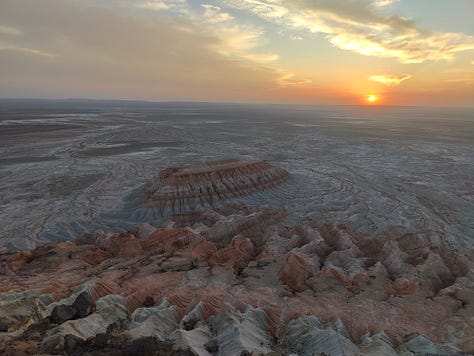
Resuming our journey, the Balkan mountains soon gave way to the wide, flat expanse of the Karakum desert. Buried deep within the desert was our destination; the beguiling Yangykala canyon, where, apart from herds of camels, we had the whole place to ourselves. I’ll let the pictures below describe the canyon’s beauty. A great opportunity here too to thank Putin (eek!) for being the catalyst for the cancellation of our hotel reservations! Staying overnight in the canyon ended up being a highlight of the whole Turkmenistan trip.
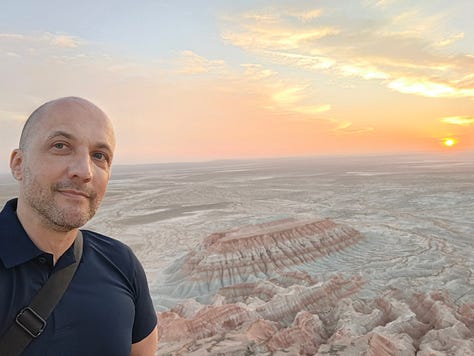
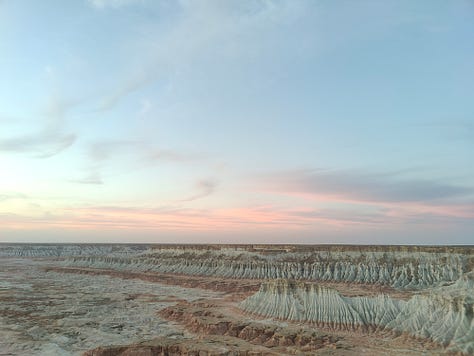
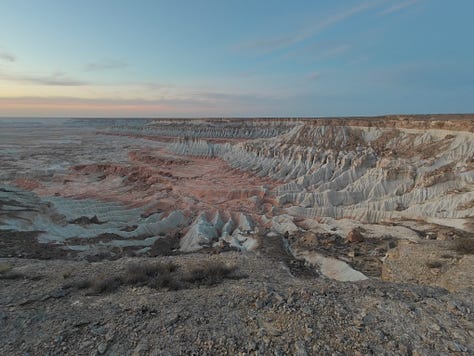
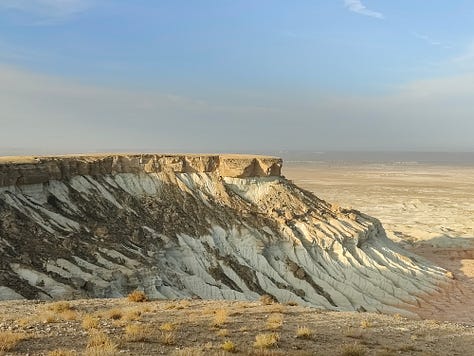
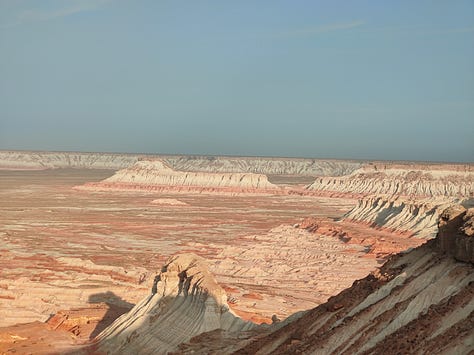
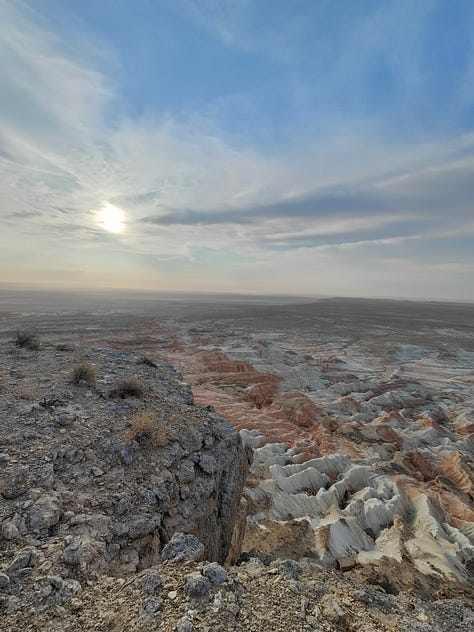
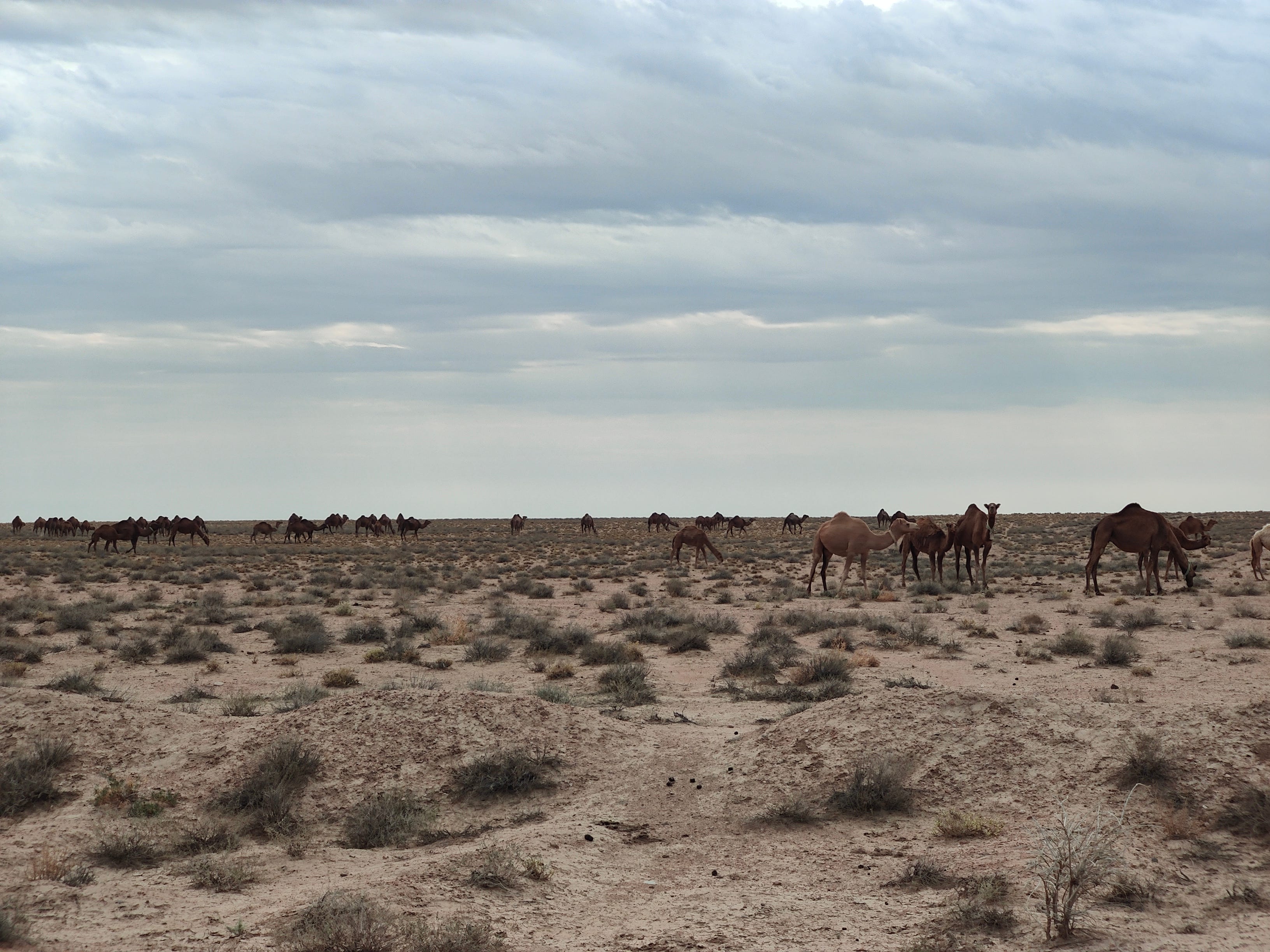
And how about those camels? Turkmenistan is famous for the Arvana, a single-humped (dromedary) camel breed developed locally over thousands of years for milk, wool and transport. They are different from the two-humped Bactrian camels most associated with Central Asia. What visitors to Turkmenistan soon notice once they venture into the deserts is the sheer number of what seem to be “wild” camels. The reality is that camels in Turkmenistan tend to be free-roaming and are generally feral or unfenced domestic stock. As unlikely as it may appear, many of these camels have owners and are tagged, but living untethered in the ecosystem. True genetically wild camels (such as the khavtagai of the Gobi Desert) are not native to Turkmenistan's deserts.
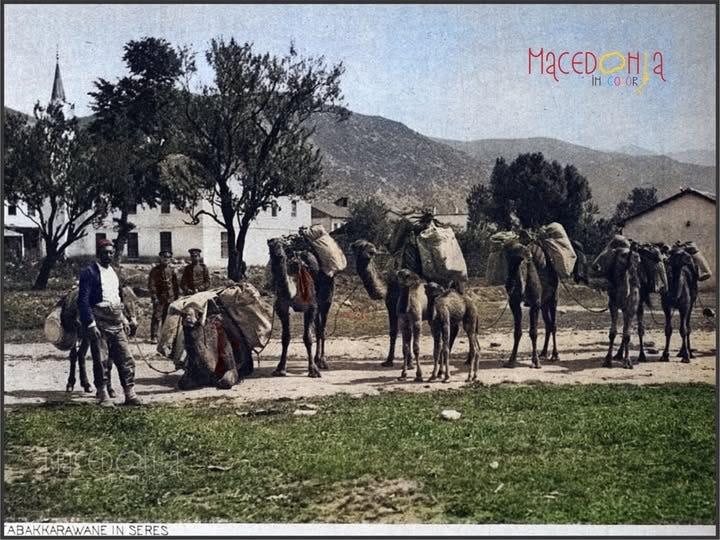
Camels, would you believe, were also a common sight in the European Balkans. During Ottoman rule, camels were used for long-distance trade caravans travelling into the southern and central Balkans. Bitola, formerly Manastir, in Macedonia was a major hub where camel trains would arrive from far-flung places such as Istanbul, Bursa and Adana. The local neighborhood where the camel caravans stayed was known as Deve Ani (meaning “camel caravanserai”). These camel trains remained a regular fixture until the fall of the Ottoman Empire in the Balkans in 1912, when modern borders cut the existing trade routes. Camels even feature in Balkan folk songs, such as in this humorous classic from Macedonia.
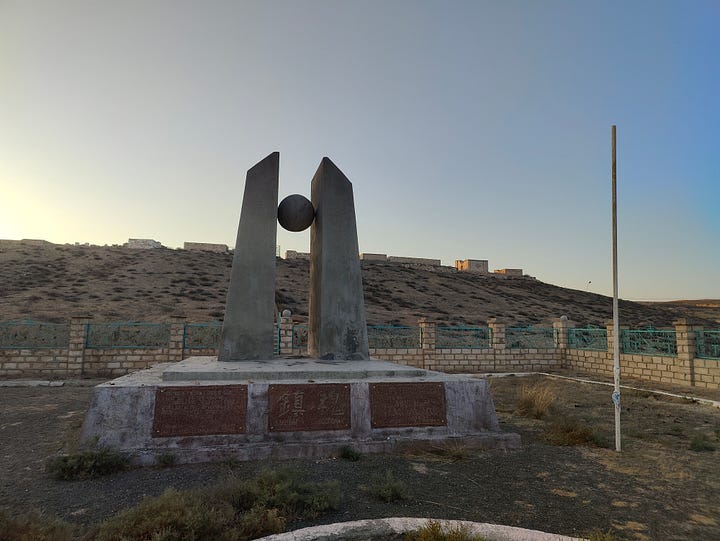
Our final stop in Balkan province was Türkmenbaşy, formerly Krasnovodsk, stunningly located on the Caspian sea coast with craggy mountains providing a spectacular backdrop. I saw it once described as having a ‘Mediterranean’ feel to it… and that’s exactly the vibe. The city had been founded by Russians as their entry point into Transcaspia, the region covering present-day Turkmenistan. After a walk around the station at the start of the Transcaspian railway, the WWII war memorial (Turkmenistan’s first president Türkmenbashi having replaced Lenin), the old streets of Krasnovodsk and the gates symbolising the illusory border between “Europe” and “Asia”, we had a guided tour around the city’s regional history museum. Like the country itself, the museum, its displays and the (Russian-speaking) guide were unchanged from Soviet times; just the original Russian inscriptions had been haphazardly pasted over with Turkmen ones, and gone here too was Lenin and crew and instead we were welcomed by a (surprisingly) modest display dedicated to the current president and the previous one (who happens to be his dad).
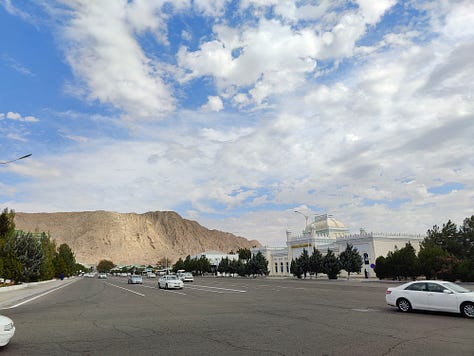
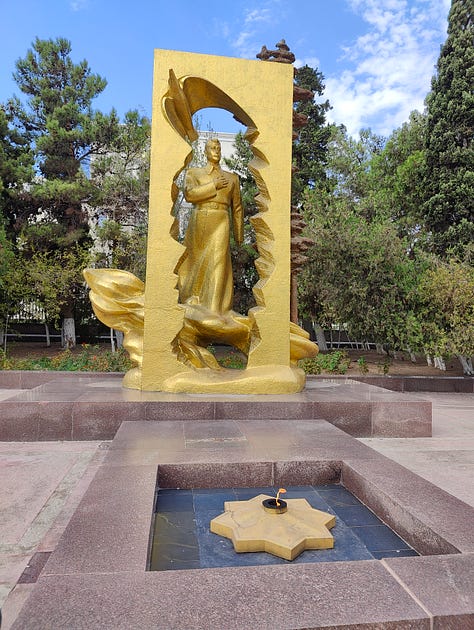
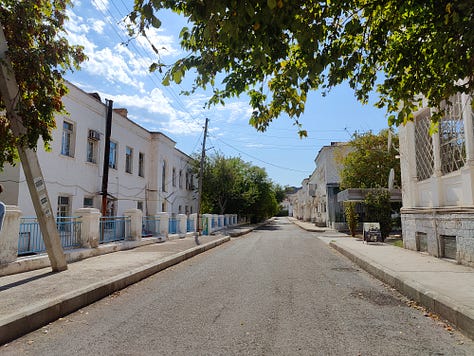
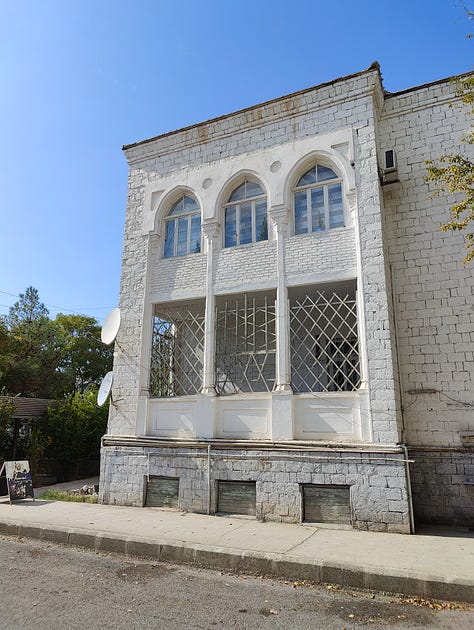
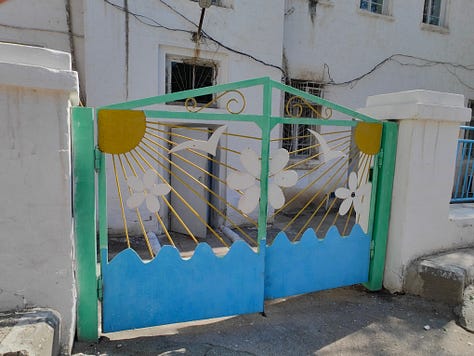
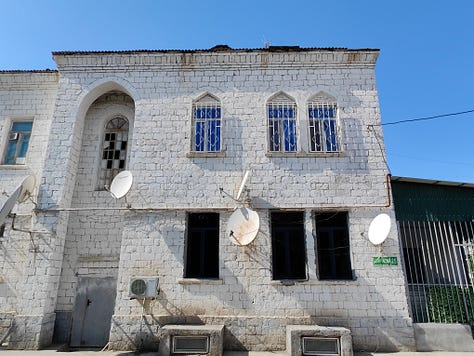
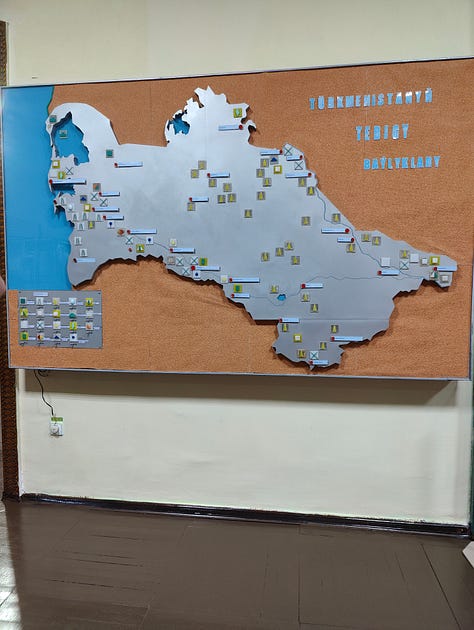
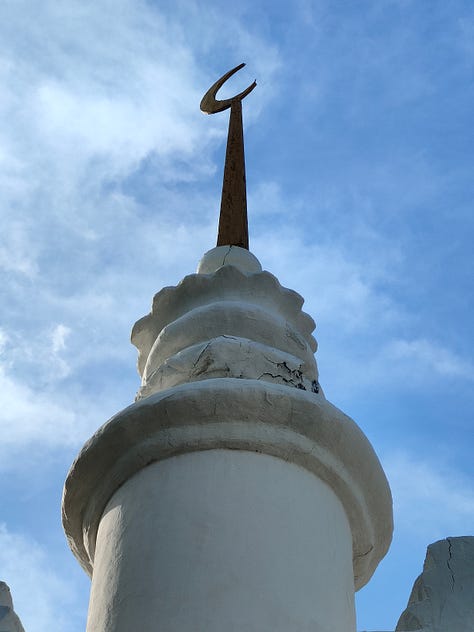
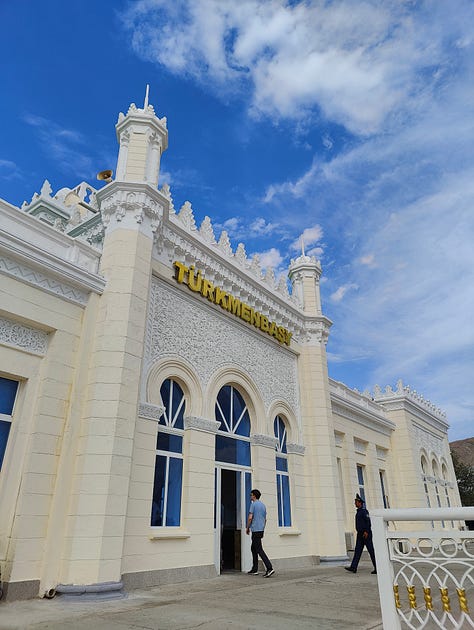
The Russian element is still visible today not only in Balkan province but all throughout Turkmenistan. Again surprisingly, despite 35 years of extensive, post-Soviet Turkmenification, especially under the eccentric rule of Turkmenbashi where towards the end of his reign some aspects of modern culture (ballet, opera) brought to Turkmenistan by the Russians were banned, the country’s Russian-speaking population (Russians, Tatars, Armenians, even Koreans) are still there, though in smaller numbers than before. Though not having any official status for three decades, Russian is still the main second language of Turkmenistan. Our guide, an ethnic Turkmen, had completed his university education fully in Russian in Moscow, marking him “highly educated” – again, just like in Soviet times. Given the opportunity, all of the officials and hosts showing us around gladly gave their talks fully in Russian, even though they were all Turkmens. One of our guides was ethnic Belarusian but had lived her whole life in Turkmenistan. She had gone to Russian-language schools (still considered to provide better quality education), and although she had Turkmen as a school subject, could hardly speak the language. But then again, she could count on one hand the amount of times in her life in Turkmenistan when she had encountered someone in the country who couldn’t at least understand Russian. She could perfectly operate in the country using her native Russian… and that did not pose a problem to anyone.
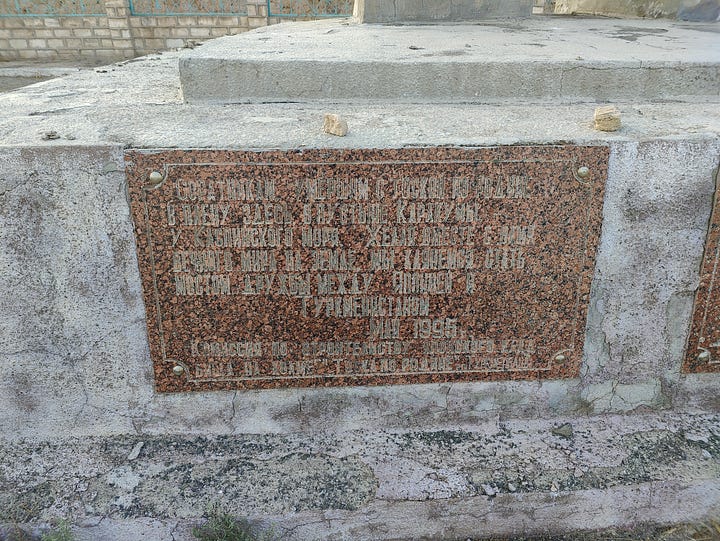
On our way to the airport for our flight back to Ashgabat, we passed by the Japanese POW memorial and cemetery. Thousands of Japanese POWs had been put to gruelling work, most notably carving with pickaxes the tunnel we had just gone through to get there. Our guide told us that the few survivors feared the shame they’d face if they returned to Japan, so they opted to stay, eventually intermarring with locals. Because of this Japanese element, to this day people from Türkmenbaşy have the reputation of being the best looking people in Turkmenistan (according to our guide).
Getting to the airport proved to be a challenge. Security officials had blocked all the roads, so our drivers inventively were able to bypass the checkpoints by going through some of the less glamorous parts of the outskirts of Türkmenbaşy. You don’t see these areas in the brochures or on TV. Arriving at the airport terminal, we saw a heavy security presence, but our guides did what they needed to do to get us into the terminal.
Why this major security presence?
Of course, Putin was just about to arrive at the airport in his VIP plane for his official two-day visit to Turkmenistan and participate at those regional summits. Great timing!
Clearing security, we were hearded to a seated area just as a whole wave of (mainly Russian) journalists and camera crew descended towards the gates. At the same time, we saw a huge group of people, some brandishing huge bouquets of roses, gathering around a young women immaculately dressed in traditional Turkmen clothing. One of our group members, an English teacher by profession, started chatting with some of the teenage girls in the crowd. Speaking in excellent English, they said they were there to bid farewell to their teacher (the immaculately dressed woman), who had recently wed and was now on her way to Ashgabat to then fly to Moscow to start her new married life there. The links with the stolitsa (“capital”) are obviously still strong.
One thing that having the journo pack around us for the summit allowed was for the airport to provide a special WiFi network… that was fully unblocked. Turkmenistan ranks at the bottom for press and internet freedom, and going by official channels access to most international social media and news platforms is blocked. That however doesn’t stop many locals from accessing them, as most know to use VPNs.
We only had to wait an hour before the press gang was gone and security eased to allow us to get to our domestic flight to Ashgabat. And how close did we get to Putin? Well, the official Russian delegation planes were right next to our humble Boeing 737. No photos – I didn’t want to push the boundaries. So my group and I were waiting in the termimal in the background of the footage below…
So do both Balkans have much in common? Well, far more than expected. C’mon, no-one could have told me about that Balkan cheshma in the Balkan mountains! Perhaps the Russians were on to something there in having to make that change in letter to give both regions a linguistic uniqueness because otherwise, if a Russian traveller back in the day were to give an account of the Balkans, it would’ve been hard to work out which one out of the two that traveller was talking about.
*Some names and identifying details have been changed here to protect the privacy of individuals.
Unless otherwise credited, photos © Nick Nasev 2026
Map: Balkan province, in purple, Turkmenistan. Credit: Peter Fitzgerald, amendments by Alexander Tsirlin, CC BY 3.0, via Wikimedia Commons