Ask what’s most unique about Australian English and the answers usually are our accent and slang. Correct!
But there’s more to Australian English that makes it unique. We also have a number of uniquely Australian English words in regular use, even in formal situations and text. The thing is that Australians are surprised to find many of these words, verbs and terms are not used everywhere else in the English-speaking world. OK, sometimes also in New Zealand, but definitely not always.
Now here’s a word that pops up quite a bit in Australian discourse, whether it be everyday speech, news articles or even in stuffy Australian legislation…
Spruik (verb)
So what does spruik mean?
According to the Macquarie Dictionary, the authority on all things Australian English, there are three definitions:
1. to harangue or address a meeting
example: to spruik the benefits of a unionised workforce
2. to harangue prospective customers to entice them into a show, strip joint, shop, etc.
example: the guy is outside with his loudspeaker spruiking for customers
3. to promote; argue publicly for
example: to spruik the new legislation
The second definition has been the primary one for most Aussies. In that sense, it means the same as “to tout” or “to bark”. The person who does the spruiking is a “spruiker”, i.e. the (often annoying) person who stands outside of a shop or restaurant, often with a microphone or loudspeaker, and lures people to come inside based on a constant blathering of offers and suggestions. For decades, spruikers, often a local radio or morning TV personality, with microphone, amplifier and a curious cart with a red light on top in tow, were regular features inside Australian department stores, enthusiastically advertising all the latest bargains and “specials” (“discounts”) available.
Some spruikers have gone on to become minor local celebrities, such as Frank Ratta in Adelaide, South Australia, who’s permanently been spruiking (practically living) outside of department store Harris Scarfe on Rundle Mall since time immemorial.
Need a visual guide for a spruiker? Then check out this clip by 2000s Australian political satirists The Chaser and the character The Surprise Spruiker…
Hey, if you’re like many Aussies and are an old-school Simpsons fan, then what Ned Flanders and Homer Simpson did at the Evergreen Terrace Rummage Sale here is what Aussies call spruiking
The verb “to spruik” also generally means “to promote”, “to plug” or “to pitch”. Previously, it solely had a negative connotation, as in selling a product in an excessive, tacky or aggressive manner. Nowadays “spruik” has lost a lot of that baggage and overall has a more neutral sense.
Example: He was spruiking his new product on social media the other day.
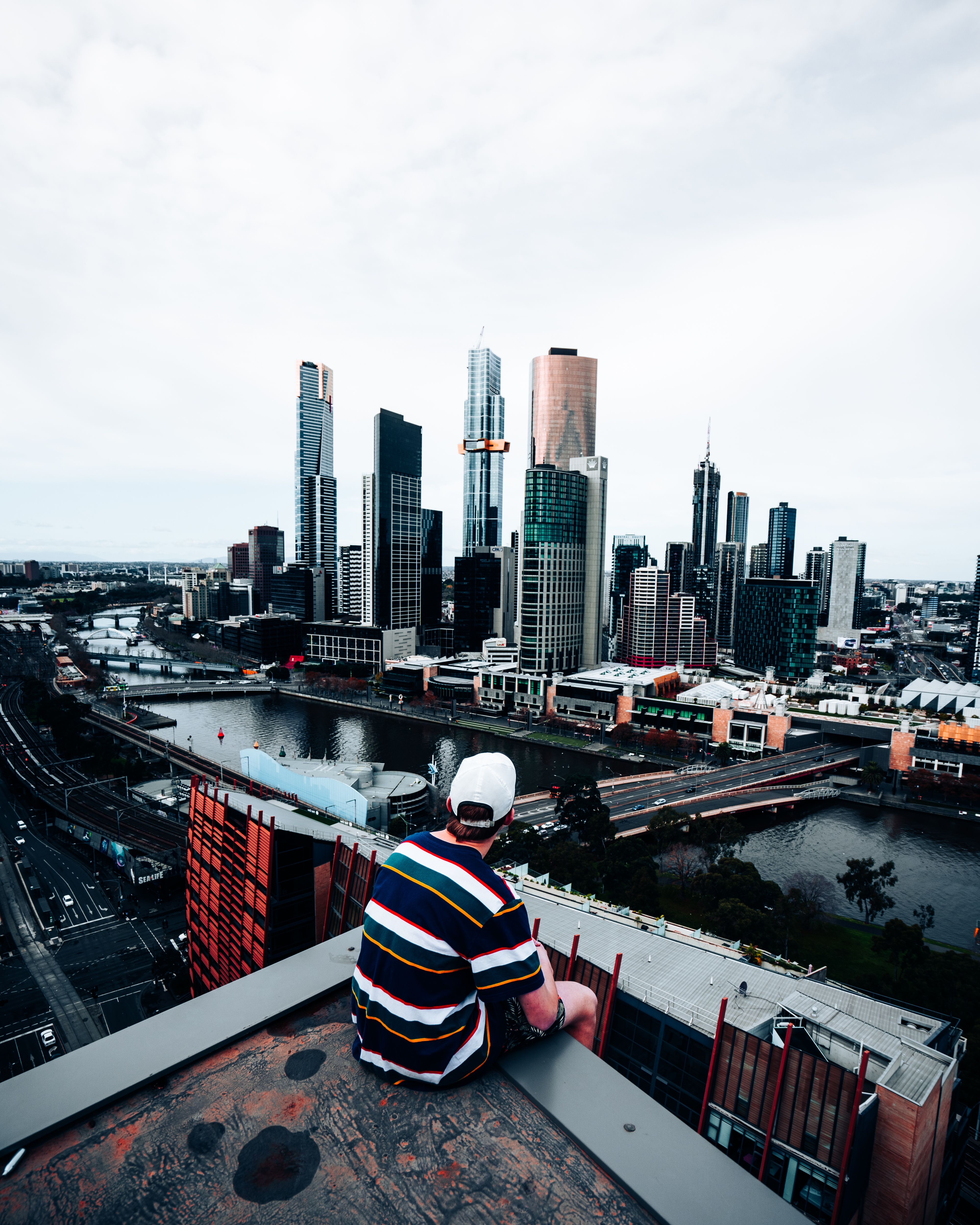
Spruiking is such a mainstream word in Australia that Melbourne City Council has a local law clearly stating that spruiking is banned unless a special permit is obtained. Meanwhile in Preston, in the northern suburbs of Melbourne, its fresh food market has been home to numerous spruikers since its inception in 1970; so, it was only fitting that a spruiking championship be held on its premises in 2022.
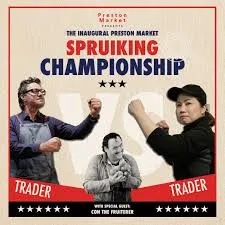
So where did the term spruik come from?
Like many uniquely Australian terms, no-one really knows.
Based on its spelling, one long-held theory claimed it was of Dutch/Afrikaans origin. Meaning “speak”, it was believed Australian soldiers who had fought in the Second Boer War (1899–1902) in South Africa brought the term back with them. However, the oldest reference of “spruik” found so far has been in a newspaper in Tasmania in 1894, i.e. before this war. So that’s that theory out the window.
The other theory has it that it comes from a German dialectal word for “speak”. That same Tasmanian newspaper that first mentioned “spruik” in 1894 also used a year before “sprucher”, which is closer to the standard German word “sprücher” for “speaker”. Given there were large numbers of Germans, most speaking German dialects as opposed to standard German, who settled in certain parts of Australia in the 19th century, and who in turn contributed to the local vernacular (South Australia in particular), this theory seems more likely the case.
So the next time an Australian is caught spruiking, whether advertising specials inside or outside a once-bustling department store, plugging a new product on the net or promoting a piece of legislation in parliament, why bother thinking of the term’s supposed origin – most Australians haven’t the foggiest. They’re instead still massively surprised whenever they find out they’re the only ones who spruik spruik.
Interested in finding out more about the quirks of Australian English? Contact me at info@nicknasev.com and let's have a natter!
Photo credit: Srattha Nualsate: https://www.pexels.com/photo/a-hand-holding-a-microphone-12997263/








_(8249451687).jpg)




.jpg)













.jpg)






.jpg)













_logo.svg.webp)


_(52052470251)_(cropped).jpg)









.jpg)