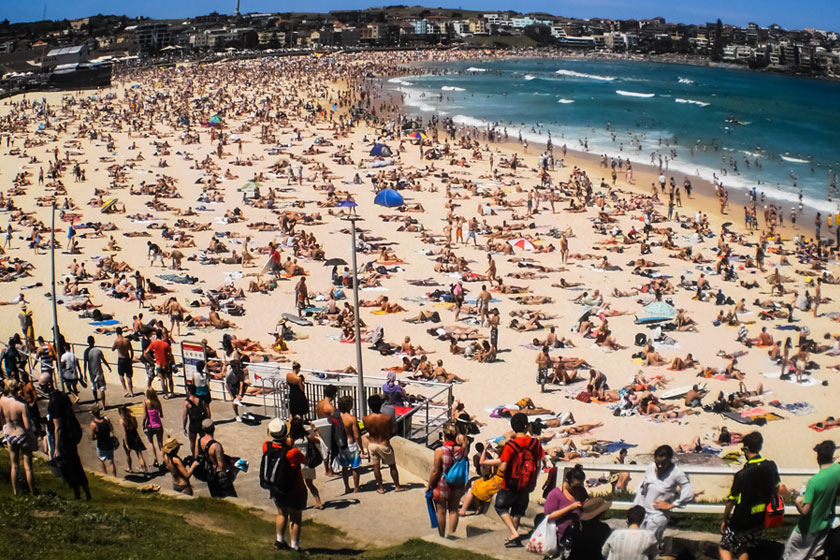
Long, 40-degree days of bright sunshine on the beach or at home with the air-conditioning on at full blast... welcome to Christmas in Australia!
A few years back, I put the call out to people to ask me anything about how do Aussies do "Chrissie" (as we like to call it). So here are the responses...
Are there special carols that are about a summery Christmas? I feel like a lot of carols mention snow and winter.
Yes, there are Aussie Christmas carols. Most of them are with familiar Christmas tunes but their texts have been revised to fit the Aussie (summer) circumstances. One of the most popular and original Aussie Christmas songs was Six White Boomers composed by (the late and very disgraced) Rolf Harris, where Santa's reindeers have been replaced by six white "boomers" (a now-obsolete Aussie slang word for "kangaroo", to make that clear). A list of the most well-known Aussie Christmas songs can be found here. Otherwise, you'll find that Aussies in general still prefer all of your traditional Christmas carols and songs, so we're jingling our bells and singing about the fun riding in the snow in a one-horse open sleigh even though most Aussies have never been in the white stuff in their lives. Gina Riley (of Kath and Kim fame) so succinctly lampooned this with her character Eleanor de Gore, the host of "the Saturday Show" – a variety show, on the iconic Australian skit comedy show Fast Forward (1989–92). Yes, it's this ridiculous that we'll be singing about toasting chestnuts and dreaming of a "white Christmas" when it's the height of summer.
So where to sing these songs?
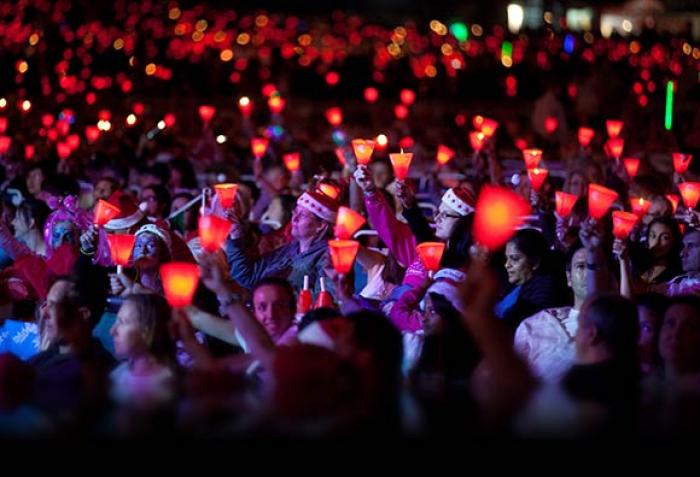
Singing carols by candlelight outdoors is originally a British tradition, but it'd be much better for all involved if the weather was warmer for such an event. That's why a summer Christmas in Australia (and in New Zealand and South Africa) is the perfect setting for a tradition where thousands of people of all ages to gather in a central park, sing all your holiday favourites and raise money for worthy causes such as the Royal Flying Doctor Service. These events are called Carols by Candlelight and they attract up to tens of thousands of people all throughout Australia in the weeks leading up to Christmas. Actually, the biggest ones held in central parks in Sydney and Melbourne are televised nationally – this is the closest Australia gets to having a traditional Christmas TV staple. The main stage always features big-name local stars and, occasionally, international ones – we're talking about the likes of Andrea Bocelli (OK, so it was via satellite in 2022) and the Wiggles here. And if you don't know the words to the songs, not to fear as the lyrics are subtitled on TV.
Now let's get to the food!
Is it true that Christmas is usually throwing a prawn on the barbie on the beach?
First of all, let's talk about the "traditional" Aussie Christmas spread. Basically, it was the same as your typical British Christmas fare, so a roast, boiled vegetables and loads of gravy (made on "Gravy Day" on 21 December), along with minced pies and Christmas pudding. Perfect food for a winter's night. But when it regularly gets to 40+ degrees (Celsius, not Fahrenheit) in many parts of Australia at the end of December, it's not really the most appropriate menu, and the poor cook having to slave over a boiling stove preparing that! So things have changed food-wise for your typical Aussie Christmas over the past couple of decades, adapting to what is more seasonal for Australia.
When you sit down at the nicely decorated table and before tucking into the meal, Australians crack a Christmas bonbon (the Australian term for what Brits call a "Christmas cracker") with the person sitting next to them. Traditions dictates that you must put on your ill-fitting paper hat, laugh at the lame dad joke inside and wonder what that plastic "toy" that came inside the cracker is all about. All part of the fun. Be sure to wear your paper hat for the entire meal.
The big meal tends to happen for Christmas Day lunch, and usually it's very possible to have it outdoors, so a barbie (BBQ) is definitely an option – so long as there isn't a total fire ban – but not on the beach itself as lighting fires on Australia's beaches is actually illegal.
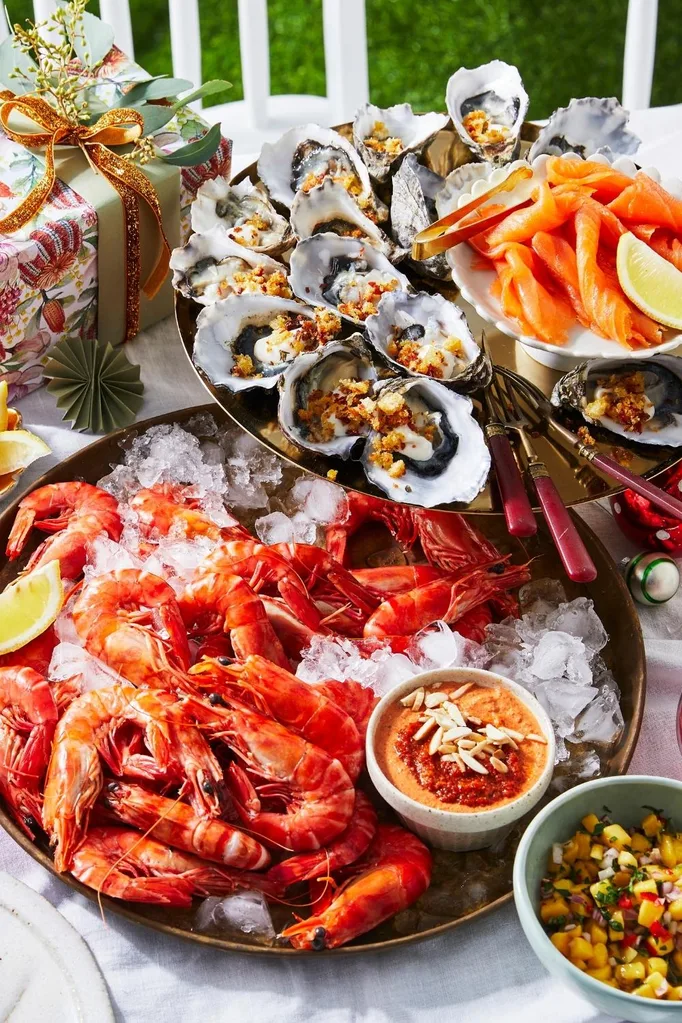
Instead of a roast, Aussies have gone en masse to having seafood for Christmas, such as prawns, oysters, crayfish, lobster or your top-range fish such as barramundi. Seafood retailers all throughout Australia have their busiest trading days in the lead-up to Christmas, with some of them open 24 hours to cope with the huge crowds buying their produce. It's so mainstream now to have seafood that Aussie "pollies" (politicians) make sure to have photo shoots of themselves barbecuing fish and prawns for Christmas.
Turkey and hams still have their place on the table for an Australian Christmas, but when the Christmas day weather forecast is for yet another heatwave, these traditional items are then best served cold.
And what's better at this time of the year than having fresh salads to go with your mains. But seeing that this is a special occasion, Aussie Christmas salads tend to be more elaborate than usual, coming mixed with a wider range of seasonal, unusual and, invariably, more expensive ingredients. You can even pre-order special Christmas salads from food retailers.
Old-school Christmas puddings with custard, (sweet) mince pies and trifles are still popular as desserts, but Aussies now opt more for a summery pav (Pavlova), topped with kiwifruit, strawberries and mango; plus cherries and apricots, as they're in season at this of the year in Australia.
For drinks, it's local chilled beer, a light local Sav Blanc (SB) or Semillon Sav Blanc (SSB), and for the kiddies it's soft drinks or a refreshing juice as it's a special occasion.
Mulled wine? Eggnog? Forget it as most Aussies have no idea what these are.
You can read up more about how the Australian Christmas spread has changed over the decades here.
Does everyone decorate fir trees or are other trees preferred? Do a lot of people go for plastic trees?
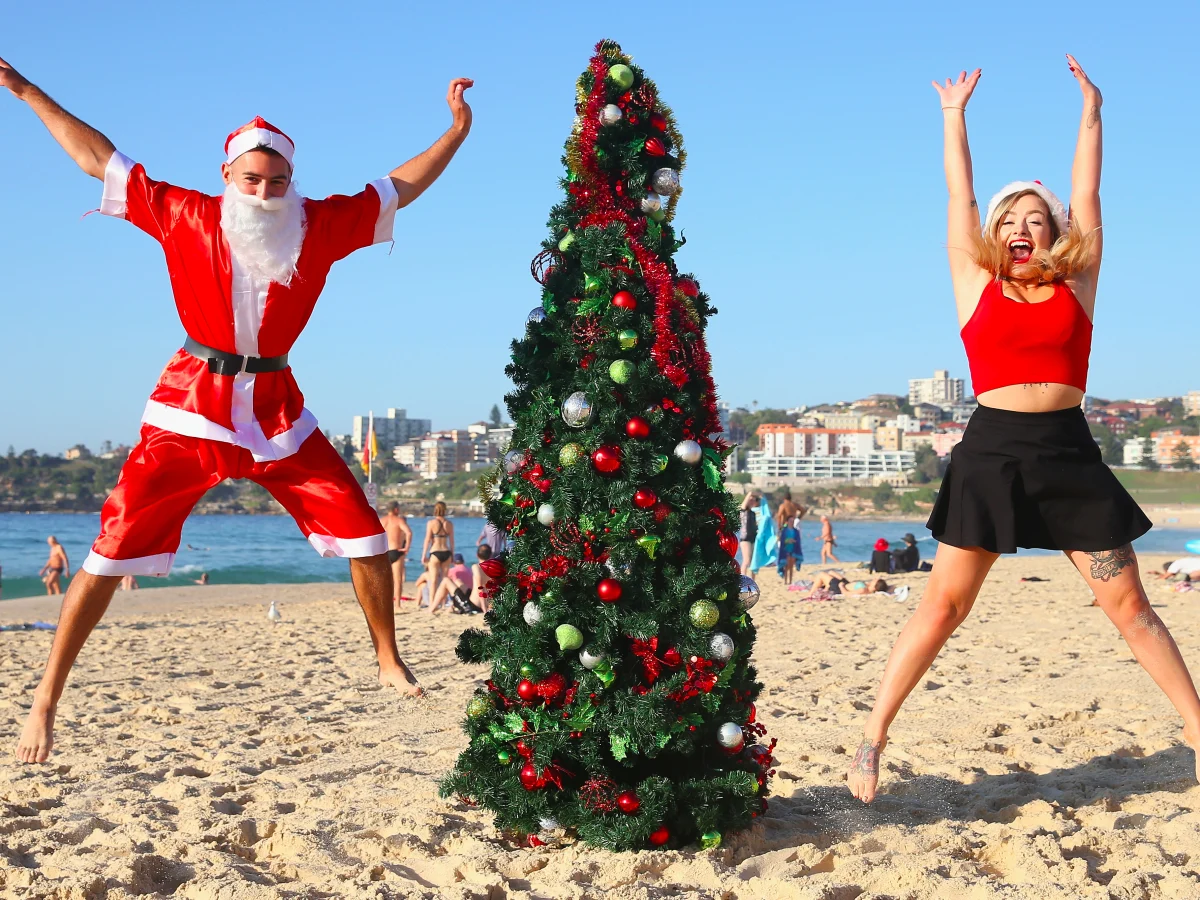
Now this has been a topic of fierce debate in recent years in Australia. Traditionally Aussies have had no option but going for plastic trees, and there are a few reasons for this. Real Christmas trees only started to become widely available for sale in Australia in the 1980s, but they at first didn't look as glamorous as the ones we'd see on US TV shows and were quite expensive, so the novelty wore off. However, as the industry has expanded over the years, the stock now available looks more like traditional Christmas trees and is more affordable. However, the hot and dry/humid December weather in Australia and constant, ever-present air-conditioning cause real trees to dry quickly, making them smell, lose their colour and shed their needles – something not encountered with plastic trees.
Australians were puzzled over the huge uproar when the US First Lady at the time, Melania Trump, opted for artificial trees instead of going traditional with real pine trees for the Christmas decorations at the White House. The Australian response was: "What's so bad about artificial trees? We use them all the time for Christmas."
Aussies often claim that they go for plastic trees on environmental concerns. The trees can be reused for many years (my parents have had their plastic tree for more than 40 years) and avoid the use of an introduced tree species (pinus radiata, native to California; Australia has a poor history of introduced species destroying native habitats). But according to experts, the more environmental option is the real thing: "While it's obvious that cutting down trees is bad for the environment, the most commonly sold Christmas trees from Australian nurseries are plantation-grown. That means in most cases the farmer will replace them straight after they are cut down, and in the meantime they are providing habitat for local birds and enriching the environment by absorbing carbon dioxide. Pine plantations are also generally grown in areas that are otherwise unusable for other crops." Dr Weston, from the University of Melbourne’s School of Ecosystem and Forest Sciences: "We’re not destroying native vegetation to grow Christmas trees but in land already cleared for agricultural plantation purposes, with pinus radiata being the major softwood timber or species planted for timber in Australia."
One uniquely Australian Christmas tradition is that you'll occasionally find the Norfolk Island pine trees that are found at prominent beachside locations all throughout the country decorated with Christmas lights and/or decorations.
Let it snow, let it snow, let it snow... as the popular Christmas song goes. There's very little chance of that happening in the summer of Australia... but not no chance – it has been known to snow (albeit lightly) on Christmas Day in the upper regions of Australia! With Christmas so associated with "winter wonderland" scenes, this question gets asked a lot...
Christmas cards in the Northern Hemisphere tend to have snowy scenes, holly, etc. How about Down Under?
Absolutely!!! Definitely not as much as it was the case a few decades ago, but previously most Christmas cards in Australia would show snowy scenes never encountered in most areas of Australia even in the winter. It's a bit difficult to avoid this though when it comes to Santa, who we all know resides in the North Pole/Lapland.
One of the traditions in Australia is for shops and businesses to have elaborate window displays and/or decorations for Christmas. The usual shop window often used to feature a winter wonderland scene very much at odds with the shoppers walking by in shorts and t-shirts. Such displays have become rarer these past few decades as Australians have been gradually adapting Christmas celebrations to fit the weather, but you still get a snowman, reindeers, Santa's North Pole workshop covered in snow or some other Northern winter-related feature to scream "Christmas", like in the photo below. And yes, all those poor Santas (or, as many older Aussies will be adamant in calling, Father Christmas) in Australia are dressed up in heavy winter gear too!
However it's quite ironic that Aussies still associate Christmas with winter wonderland images, even though most Aussies have never even been in snow in their lives, let alone experience this ever at Christmas time.
Like in the UK, holly rings are usually hung on front doors of residences. However, holly is not in season in Australia during Christmas, so whenever holly is seen, it's usually artificial/plastic.


Another question often asked is...
Do Aussies decorate their houses with lights for Christmas?
The days around Christmas are the shortest for daylight in the year in the Northern Hemisphere, so there's no better way to bring some cheer to what seems like a never-ending night than putting up a bright and colourful light display or going to see one. Hey, let's not kid ourselves here – Christmas is an adaptation of a previous pagan celebration of the winter solstice – another festival of light for the darkest part of the year, just like Hannukah and Diwali. So this is where Christmas in the Southern Hemisphere, during the time of the longest days of the year, comes at odds. Still, as a vestige (yet again) of English Christmas traditions mixed with a big dose of Hollywood movie fantasy, Australia has been getting into Christmas light displays.
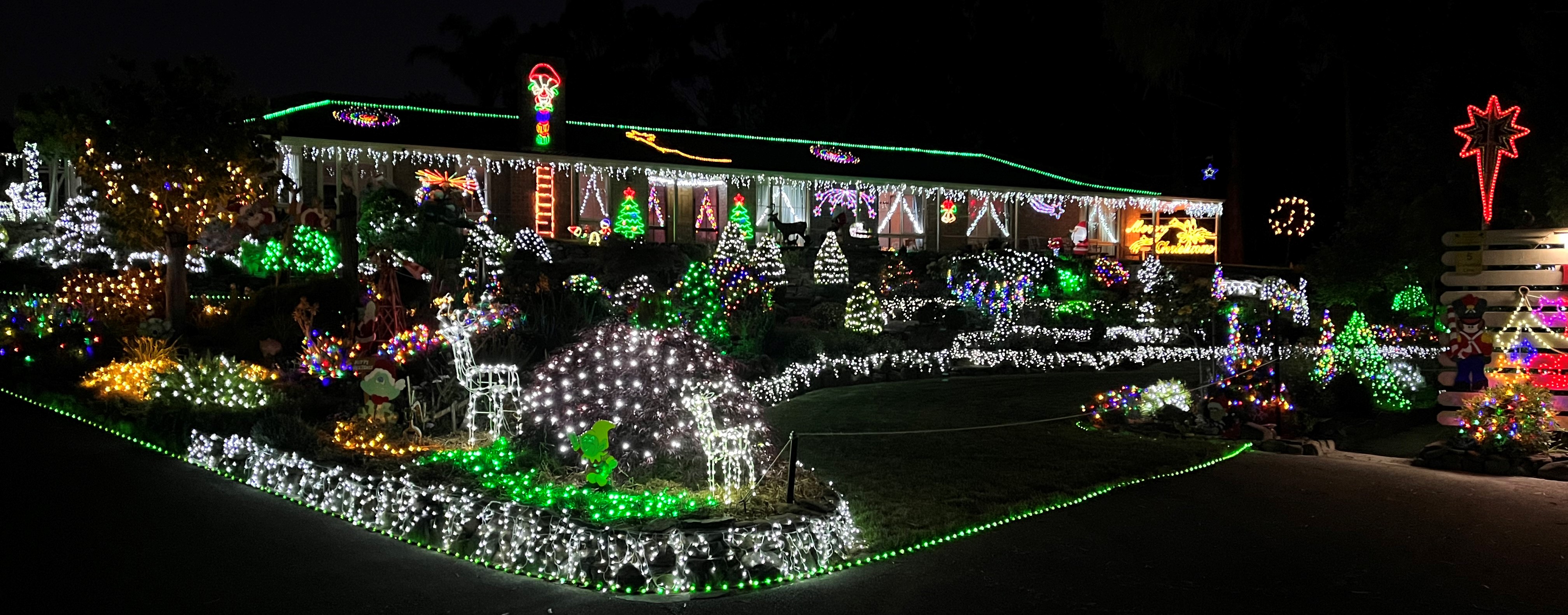
Australians traditionally don't decorate their houses with lights, but this has been changing over the past few decades, where there's now the odd house in the neighbourhood with some lights. But one thing that has been around for a while is that usually in a given city or region, there's a whole street or suburb or even town known locally to put on a full-on light display for people to come and admire, and even leave donations for charity or to pay for these expensive displays. There's even a website dedicated to locating light displays near you. Of course, as the sun sets after 9 pm in most populated parts of Australia, it can be a late night for the kiddies taking them to see the lights, and for the most popular and well-established displays be prepared to deal with traffic jams – just ask the residents of the town of Lobethal, South Australia with their Lights of Lobethal Festival.
In recent years though, many people who once would decorate their houses with Christmas lights have stopped doing so, citing the huge costs involved as their main reason for flicking the switch off.
And then there's this aspect...
Does it ever get cold enough at this time of the year for Aussies to show off an ugly Christmas jumper?
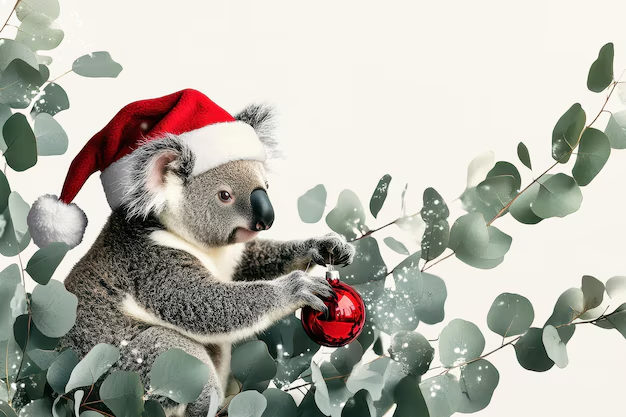
Well, in the lead-up to Christmas 2022, there was unseasonal cold weather in southern parts of Australia – "cold" meaning 14–18 degrees, which was jumper weather for Aussies. At the time I saw a viral social media post showing two Tasmanian blokes wearing Christmas jumpers, which prompted many to ask "is it that cold in Tasmania?" Otherwise, no, it's an Australian summer so it's usually too hot for Christmas jumpers. Often the most Chrissie thing Aussies wear are Santa or reindeer antler hats. However, retailers in Australia still push their luck with selling Christmas jumpers, and sometimes it works out – an unseasonal maximum of 16°C is predicted for Christmas Day in Melbourne, so locals will have jumpers, ear muffs, scarves, thick puffy parkas... the works out as that temperature for the people of Melbourne is winter. Compare that to Perth where Christmas regularly gets to 40°C. The worst weather happened in Christmas 1974 when Cyclone Tracy destroyed the northern tropical city of Darwin – please not again!
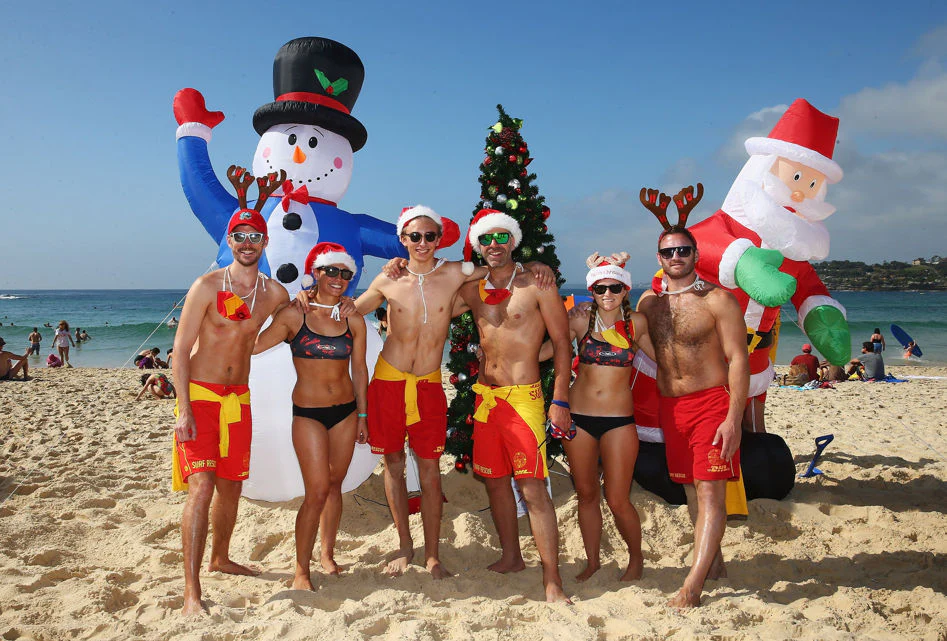
It's not just the heat...
Does Santa ever has to worry about the wildlife when delivering presents in Australia?
Well first, Australian Customs and Quarantine promptly processes and grants Santa's request to bring his reindeer into Australian territory (a difficult task during the pandemic), but Aussie kids are sometimes told that Santa gives his reindeer a bit of a rest when it comes to Australia (thinking of their occupational health and safety – it's the heat) and employs six local white kangaroos to do the heavy lifting for that leg (refer to the "Six White Boomers" song above). Otherwise, the snakes, crocs, spiders and noahs (sharks) stay quite clear of Santa as they know he knows they've been quite bad and not good.
Wishing you a wonderful Chrissie wherever you are! 🎄🎁🌟































.%20A%20day%20of%20campaigning%20%E2%99%80%20%E2%80%A6%20or%20a%20day%20to%20buy%20flowers%20%F0%9F%92%90.jpg)